Chapter One

Biology & Anatomy

A lichen is not one organism but many — a fungal body housing photosynthetic partners, possibly yeast accomplices, and chemistry no single species could produce alone. Here is how it all works.

What Is a Lichen, Really?

Pick up a lichen and you appear to be holding one thing — a crust, a leaf, a tiny shrub. But every lichen is a stable symbiotic partnership between a fungus (the mycobiont) and one or more photosynthetic organisms (the photobiont): green algae, cyanobacteria, or both. The fungus builds the body, absorbs water and minerals, and cannot photosynthesize on its own. The photobiont manufactures sugars from sunlight. Together they create an entity that neither partner could sustain alone, colonizing habitats (bare rock, desert crusts, arctic tundra) that would kill either organism in isolation.

The fungus dominates: it makes up 80–90% of the lichen body and dictates the overall form. Lichenologists name each species after its fungal partner, because the same alga can appear in dozens of visually unrelated lichens. The photobiont is the engine; the fungus is the architect.

“A lichen is not an organism. It is an ecosystem compressed into a sliver of tissue.”

A Discovery That Was Ridiculed

For most of scientific history, lichens were classified as simple plants. In 1867, Swiss botanist Simon Schwendener proposed the radical idea that they were actually a symbiosis: a fungus parasitizing an alga. The lichenological establishment attacked him for decades. It took until the early twentieth century for his dual-hypothesis to become accepted science. Then in 2016, everything shifted again.

The Third Partner. In 2016, Toby Spribille and colleagues published a landmark paper revealing that basidiomycete yeasts live embedded in the cortex of many macrolichens. These yeasts appear to contribute to chemical defenses and may explain long-standing puzzles, like why two lichens sharing the same fungus and alga can look entirely different. The answer: they harbor different yeast strains.

The Partnership

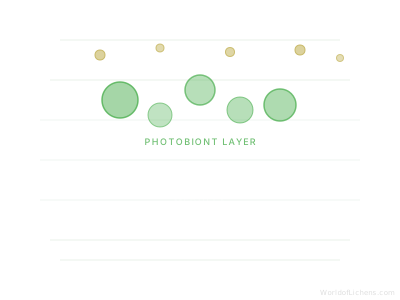
Diagram showing the three symbiotic partners in a lichen body: fungal hyphae forming the structural framework, green algal photobiont cells below the upper cortex, and basidiomycete yeasts embedded in the cortex

Three Organisms, One Body

The mycobiont (fungus) forms the structural framework: the dense outer cortex and the airy medulla. It absorbs water and minerals from rain, fog, and dust.

The photobiont (green algae or cyanobacteria) sits in a thin layer just below the upper cortex, positioned to catch light. It manufactures all the sugars the partnership needs.

The basidiomycete yeasts, discovered in 2016, embed themselves in the cortex. Their exact role is still debated, but they likely produce defensive chemicals and may influence the lichen's external appearance.
Two Types of Photobiont, Three Types of Partnership

Green Algae

The most common photobionts. Genera like Trebouxia, Trentepohlia, and Coccomyxa produce sugars efficiently through photosynthesis. A single algal species can partner with hundreds of different fungi, generating lichens that look nothing alike. The alga is a universal battery; the fungus decides the body plan.

Cyanobacteria

Partners like Nostoc and Scytonema can both photosynthesize and fix atmospheric nitrogen, converting N2 gas into biologically usable ammonia. This dual capability makes cyanolichens critical pioneers on bare rock and nutrient-poor substrates where nitrogen is essentially nonexistent.

Tripartite lichens get the best of both worlds. Species like Lobaria pulmonaria house green algae as the primary photobiont for efficient sugar production, plus cyanobacteria sequestered in special internal structures called cephalodia. The cephalodia act as nitrogen-fixing nodules, giving the lichen access to both carbon and nitrogen from the atmosphere alone.

Cross-Section Anatomy

Slice through a foliose lichen and you find a layered architecture as deliberate as any engineered material.

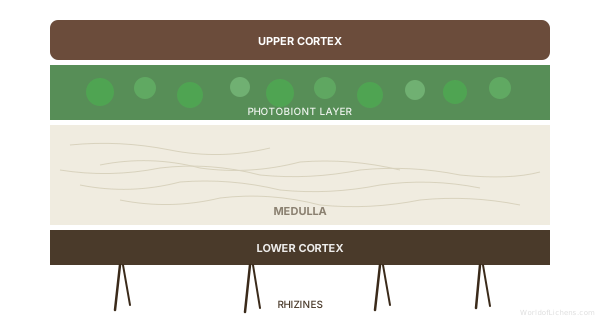
Cross-section diagram of a typical foliose lichen showing four tissue layers: dense upper cortex, photobiont layer with green algal cells, loosely woven medulla, lower cortex, and root-like rhizine attachment structures
Figure 1. Schematic cross-section of a typical foliose lichen showing the four tissue layers and rhizine attachment structures. Crustose lichens lack a lower cortex and rhizines; their medulla bonds directly to the substrate.

Upper Cortex

Dense, tightly woven fungal tissue that acts as the lichen's skin. Transparent enough to let light reach the photobiont below, yet tough enough to shield against UV radiation, desiccation, and grazing. Often contains pigments (melanins in sun-exposed species, usnic acid creating yellow-green hues) that serve as sunscreen. In 2016, basidiomycete yeasts were found embedded here.

Photobiont Layer

The food factory. A thin band of green algal cells or cyanobacteria positioned just below the upper cortex to intercept maximum sunlight. Fungal hyphae press against the photobiont cells with specialized contact structures called haustoria, through which sugars are transferred to the fungus. This is where all photosynthesis happens.

Medulla

The bulkiest layer: a loose, cottony network of fungal hyphae with abundant air spaces. This open architecture allows gas exchange (CO2 in, O2 out) while storing water like a sponge. The medulla is usually white, which matters for identification: chemical spot tests (K, C, KC, P) are applied to medullary tissue to detect diagnostic acids. Many unique lichen compounds (over 800 known) are produced and deposited here.

Lower Cortex

A dense fungal layer mirroring the upper cortex, though often darker. It protects the medulla from below and anchors attachment structures. Absent in crustose lichens, which fuse directly to their substrate. In some species, the lower cortex bears cyphellae (cup-shaped pores) or pseudocyphellae (simple breaks) that facilitate gas exchange.

Attachment Structures

How the lichen holds on to its world. Rhizines are root-like bundles of hyphae in foliose lichens. An umbilicus is a single central stalk, found in umbilicate species like rock tripe (Umbilicaria). Fruticose lichens use a simple holdfast. Crustose lichens skip the question entirely: the lower medulla bonds directly to rock or bark, inseparable from its substrate.

Other Structures Worth Knowing

Thallus

The entire lichen body. Unlike plants, it has no roots, stems, or leaves, just the layered tissue described above. The thallus can range from a thin crust a fraction of a millimeter thick to pendulous strands several meters long.

Pseudocyphellae

Tiny pores or breaks in the cortex that allow gas exchange. They appear as white dots, lines, or networks on the lichen surface. The distinctive white reticulate pattern on Parmelia sulcata is formed by pseudocyphellae.

Cilia

Hair-like projections along lobe margins. Their color, length, density, and branching pattern are diagnostic for identification. Parmotrema species are known for conspicuous marginal cilia.

Tomentum

A fuzzy, felt-like covering of fine hairs, typically on the lower surface. Common in Peltigera and Lobaria. Helps trap moisture and may protect against invertebrate grazers.

Eight Growth Forms

Eight distinct body plans for conquering every surface on Earth: from paint-thin crusts fused to granite to wispy filaments trailing from branches in cloud forests.

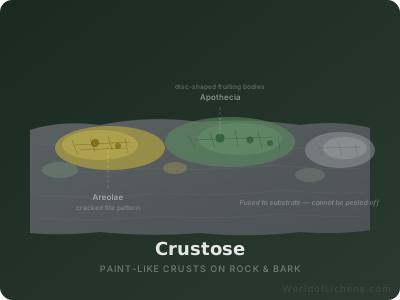
Crustose lichen growth form showing paint-like patches of yellow, green, and gray lichen fused directly to rock substrate with small apothecia fruiting bodies visible on the surface
Growth Form 1

Crustose

Paint-like coatings fused directly to rock, bark, or soil. You cannot peel a crustose lichen off its substrate without destroying both. This total integration is their survival strategy: they weather extremes that would dislodge any loosely attached organism.

Crustose lichens are the most species-rich growth form and include the oldest known living organisms. Specimens of Rhizocarpon geographicum (map lichen) have been dated to 8,600 years old using lichenometry. Growth rates can be agonizingly slow: as little as one inch per 25 years.

Graphis scripta, the script lichen, belongs here too; its lirellae (elongated fruiting bodies) look like ancient writing scratched into smooth bark.

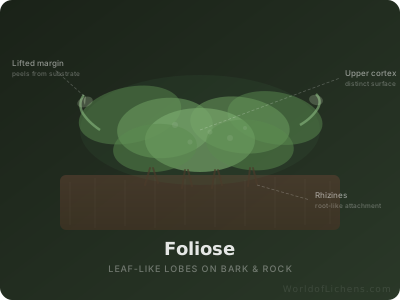
Foliose lichen growth form showing overlapping leaf-like green lobes with distinct upper and lower surfaces, attached to bark substrate by root-like rhizines
Growth Form 2

Foliose

Leaf-like, with distinct upper and lower surfaces. The key test: you can peel the edges away from the substrate. Foliose lichens attach by rhizines (root-like bundles of hyphae) or, in umbilicate species, by a single central stalk.

This is the most commonly collected and studied growth form, ranging from a centimeter across to rosettes 30 cm or more in diameter. Lobe shape, width, and branching pattern are the primary identification features.

Key genera: Parmelia, Flavoparmelia, Xanthoria (the bright orange sunburst lichen), and Lobaria pulmonaria (lungwort lichen, an old-growth indicator).

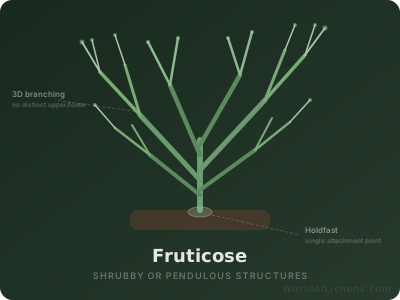
Fruticose lichen growth form showing three-dimensional shrubby branching structure growing upward from a single basal holdfast with progressively finer branches
Growth Form 3

Fruticose

Three-dimensional, shrubby, or pendulous. Fruticose lichens grow upright like tiny bushes or drape from branches in long beards. They attach at a single basal holdfast, and their entire surface is cortex; there is no distinct “upper” and “lower” side.

Because they maximize surface area exposed to the atmosphere, fruticose lichens are the most sensitive to air pollution. Their disappearance from a forest is an early warning of declining air quality.

The genus Usnea (old man's beard) has a diagnostic elastic central cord. Pull a strand gently and it stretches. Cladonia includes the famous “British soldiers” (red-tipped podetia) and reindeer lichen. Bryoria forms dark horsehair-like tangles.

The Remarkable Cladonia Architecture

Cladonia species start as a basal mat of squamules, then develop upright podetia, hollow vertical stalks that take wildly different forms:

Cup-shaped — “Pixie cups”

Cladonia pyxidata and C. chlorophaea form tidy goblet shapes. Spore-producing structures line the cup rims. Soredia may dust the insides.

Red-tipped — “British soldiers”

Cladonia cristatella produces bright scarlet apothecia atop simple podetia, unmistakable on rotting logs across eastern North America.

Branching — “Reindeer lichen”

Cladonia rangiferina and C. arbuscula develop highly branched, antler-like podetia that form deep carpets across boreal and arctic tundra. Caribou herds depend on these mats as winter forage.

Trumpet-shaped

Cladonia fimbriata produces elegant flared trumpet or horn shapes, often with delicate sorediate surfaces.

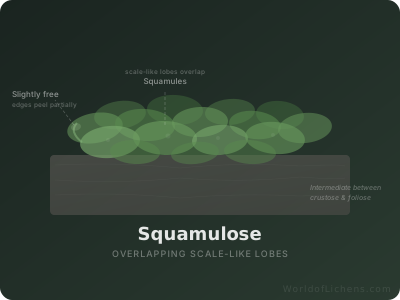
Squamulose lichen growth form showing small overlapping scale-like lobes arranged like shingles on a rock substrate
Growth Form 4

Squamulose

Small, scale-like lobes that overlap like shingles on a roof. Squamulose lichens occupy a middle ground between crustose and foliose; their lobes are tiny and have a rudimentary upper surface, but they peel only slightly from the substrate. The basal squamules of Cladonia species are a common example. Psora forms handsome tiled crusts on calcareous soil.

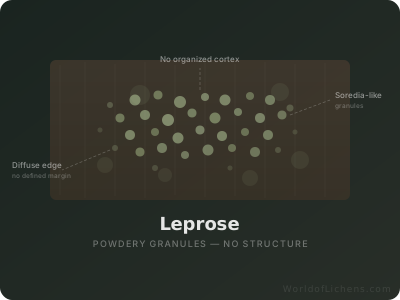
Leprose lichen growth form showing entirely powdery granular texture with no organized cortex or internal structure, appearing as pale green dust on bark
Growth Form 5

Leprose

Entirely powdery and granular, with no organized internal structure at all: no cortex, no layered anatomy. A leprose lichen is essentially a continuous mat of soredia-like granules. Lepraria (dust lichens) look like a dusting of pale green or blue-green powder on shaded bark or rock overhangs. They thrive in humid, sheltered microhabitats where more structured lichens cannot establish.

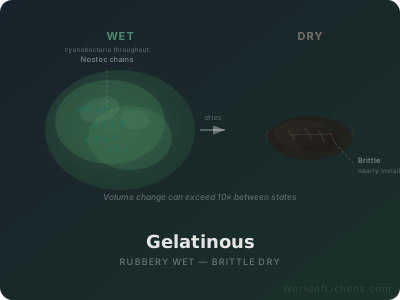
Gelatinous lichen comparison diagram showing the dramatic transformation between swollen translucent olive-green wet state and shriveled dark brittle dry state, with volume change exceeding ten times
Growth Form 6

Gelatinous

Rubbery and olive-green when wet, dark and brittle when dry. Gelatinous lichens use cyanobacteria (typically Nostoc) as their photobiont. Because the cyanobacterial cells are distributed throughout the thallus rather than in a neat layer, these lichens lack the structured anatomy of other types.

The transformation with moisture is dramatic: a dried, crispy black fragment can swell into a translucent, jelly-like lobe within minutes of rainfall. This is why they are often overlooked by beginners: they are nearly invisible when dry.

Key genera: Leptogium, Collema, Enchylium. All are nitrogen-fixers, making them ecologically important despite their unassuming appearance.

The Uncommon Forms

Two additional growth forms are less frequently encountered but complete the full spectrum of lichen body plans.

Byssoid — Cotton-like tufts in hidden places

Byssoid lichens form wispy, cotton-like tufts of loosely woven fungal hyphae. They tend to occupy sheltered, humid microhabitats: the undersides of overhanging rock faces, deep bark crevices, and the interiors of hollow trees. Their loose structure maximizes moisture absorption in the still, damp air of their niche.

Because they are rarely in plain sight, byssoid lichens are among the least collected and least studied growth forms. When found, they resemble tiny tufts of raw cotton or spider silk tinged with green or blue-green.

Filamentous — Thread-like strands forming tangled mats

Filamentous lichens consist of very fine, thread-like strands, finer even than the hair-like fruticose forms. They can form tangled mats on bark, particularly in humid temperate and tropical forests. The photobiont cells are often arranged in chains along the filaments rather than in a discrete layer.

Like byssoid lichens, filamentous forms are easily overlooked. They may be confused with free-living algal threads or fungal mycelia until examined under magnification, which reveals the characteristic interweaving of fungal and photobiont tissues.

Not all lichens fit neatly into one category. Growth forms exist on a continuum. A lichen may be crustose at the center but foliose at the margins. Cladonia starts squamulose and becomes fruticose. Some placodioid lichens are crustose centrally with distinct lobes at the edges. In the field, use growth form as a starting point, not a rigid box.

Growth Forms at a Glance

Form Attachment Remove from substrate? 3D Structure Key Genera
Crustose Entire lower surface fused No — destroys both Flat Rhizocarpon, Graphis
Foliose Rhizines or umbilicus Yes — edges peel Leaf-like lobes Parmelia, Xanthoria
Fruticose Basal holdfast Yes — lifts off Shrubby or pendant Usnea, Cladonia
Squamulose Base of scales attached Partially Overlapping scales Psora, Cladonia (basal)
Leprose Loosely aggregated Crumbles — powdery None Lepraria
Gelatinous Broad contact Yes, when wet Rubbery lobes Leptogium, Collema
Byssoid Loose hyphae on surface Yes — lifts easily Cotton-like tufts (various)
Filamentous Tangled on substrate Yes — peels as mat Thread-like strands (various)

Reproduction

Here lies the central puzzle of lichen biology. A lichen must reproduce both partners together, or the fungus must find a new photobiont after dispersal. This constraint has driven the evolution of two fundamentally different strategies: sexual reproduction (fungus only, risky) and asexual reproduction (both partners together, reliable).

Sexual Reproduction — The Fungus Goes Solo

In sexual reproduction, only the fungal partner produces spores. These spores are shot into the wind, and if they land in the right place, they must encounter and capture a compatible free-living alga or cyanobacterium to form a new lichen. It is a gamble, but the genetic recombination it provides can be worth the risk.

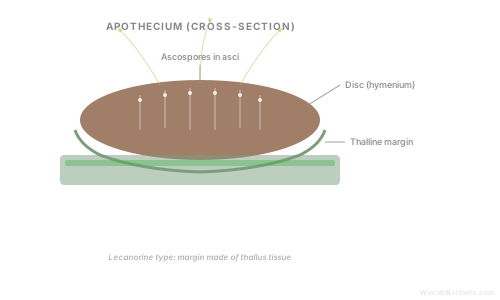
Cross-section diagram of a lecanorine lichen apothecium showing the disc-shaped hymenium containing ascospores in asci, the thalline margin made of thallus tissue with algae, and wind-dispersed spores

Apothecia

The most visible reproductive structures on a lichen. Apothecia are open, cup- or disc-shaped fruiting bodies that produce fungal spores (ascospores) via meiosis. They come in two main types:

  • Lecanorine — with a thalline margin (the rim matches the thallus color, because it contains algae). Like a saucer with a colored rim.
  • Lecideine — with only a dark, purely fungal margin. A stark disc sitting on the thallus surface.

The orange discs on Xanthoria parietina, the brown shields on Peltigera, the black dots on crustose rock lichens, all apothecia.

Perithecia

Flask-shaped fruiting bodies embedded within the thallus, invisible except for a tiny opening (ostiole) at the surface. Spores are squeezed out through this pore. Less conspicuous than apothecia, perithecia are common in crustose lichens and easily overlooked. They appear as small dark dots (like pinpricks) scattered across the thallus surface.

Lirellae

Elongated, slit-like fruiting bodies that look like lines of ancient script written on bark. They are the defining feature of the aptly named Graphis scripta (script lichen). Lirellae can be straight, curved, branched, or stellate, and their morphology is important for identification within the Graphidaceae family.

Asexual Reproduction — Both Partners Travel Together

Asexual reproduction sidesteps the fundamental gamble of sexual reproduction. Instead of dispersing naked fungal spores that must find a new photobiont, the lichen packages both partners together in a single dispersal unit. No partner-finding required. The tradeoff: no genetic recombination.

Soredia vs. Isidia

The single most important distinction in lichen identification. Two mechanisms that solve the same problem (vegetative dispersal) in fundamentally different ways.

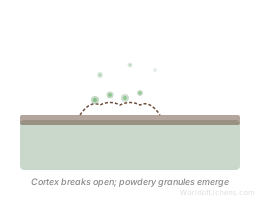
Diagram of lichen soredia formation showing the cortex breaking open at the soralium to release powdery granules, each containing algal cells wrapped in fungal hyphae for asexual vegetative dispersal

Soredia

Tiny powdery granules, each a few algal cells wrapped in a wisp of fungal hyphae. No cortex. They feel granular to the touch. Produced in structures called soralia, where the lichen's cortex breaks open to release them.

Soralia placement is diagnostic: they can be laminal (on the upper surface), marginal (along lobe edges), or apical (at lobe tips). Parmelia sulcata has soredia erupting from cracks in its surface network.

Term to remember: a lichen with soredia is called “sorediate”

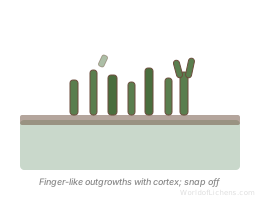
Diagram of lichen isidia showing finger-like and coral-like corticated outgrowths on the thallus surface that snap off intact for vegetative dispersal, with some showing branching patterns

Isidia

Small, finger-like or coral-like outgrowths from the thallus surface. Corticated: they have a cortex layer covering them, giving them a smooth, shiny surface. They snap off and grow into new lichens.

Isidia come in various shapes: cylindrical, globular, coralloid (branching like coral), or scale-like. Pseudevernia furfuracea bears abundant coralloid isidia. Species like Parmelia saxatilis are richly isidiate.

Term to remember: a lichen with isidia is called “isidiate”

Why does this matter so much? Many lichen species pairs are distinguished only by whether they produce soredia or isidia. Parmelia sulcata (sorediate) vs. Parmelia saxatilis (isidiate). Same genus, similar habitat, nearly identical appearance, until you reach for a hand lens and check the surface texture. Powdery granules = soredia. Shiny fingers = isidia. That distinction can determine the species.

Other Vegetative Methods

Lobules

Miniature lobes that develop along the margins or on the upper surface of foliose lichens. Larger and more structured than isidia, lobules are essentially small copies of the parent thallus. They break off and establish independently.

Fragmentation

The simplest method of all. A piece of the thallus breaks off (snapped by wind, carried by a bird, washed by rain) and grows into a new individual wherever it lands. This is especially common in fruticose lichens. Storm-blown fragments of Usnea on the forest floor can successfully re-establish on new branches.

Sexual reproduction is a lottery. Asexual reproduction is a sure thing, but at the cost of genetic diversity. Most lichens hedge their bets and do both.

Sexual Strategy

  • Structures: apothecia, perithecia, lirellae
  • Disperses: fungal spores only
  • Must find: a compatible free-living photobiont
  • Advantage: genetic recombination & variation
  • Risk: spore may never find a partner

Asexual Strategy

  • Structures: soredia, isidia, lobules, fragments
  • Disperses: fungus + photobiont together
  • Must find: a suitable substrate
  • Advantage: guaranteed partnership
  • Risk: no genetic diversity; clonal population
Continue Reading

Next: Ecology & Air Quality →

How lichens build soil from bare rock, monitor air pollution, and survive conditions that would kill nearly any other organism on Earth.