Chapter Three

Species Guide

Profiles of over 25 lichen species organized by growth form: from leafy foliose rosettes to hanging fruticose beards, gelatinous jellyskins, and ancient crustose maps written in stone.

No species match your search.

Foliose Lichens

Leafy lichens with distinct upper and lower surfaces, attached to their substrate by root-like structures called rhizines. Foliose lichens are the most commonly studied group and include some of the best-known pollution indicator species. They range from small rosettes a few centimetres across to large, spectacular lobes the size of dinner plates.

Hammered Shield Lichen
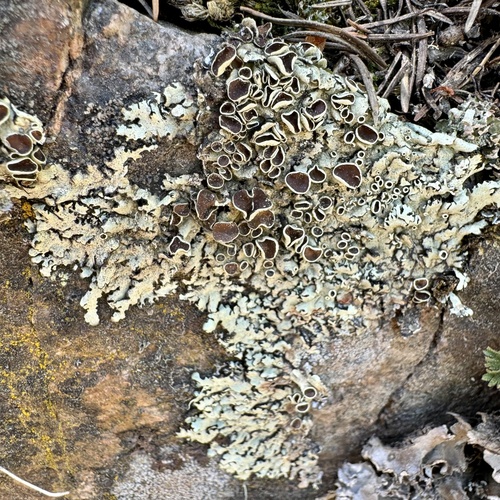
Parmelia sulcata
Foliose
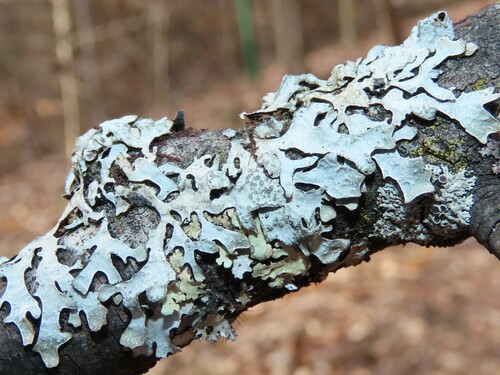
Photograph of Parmelia sulcata lichen in its natural habitat

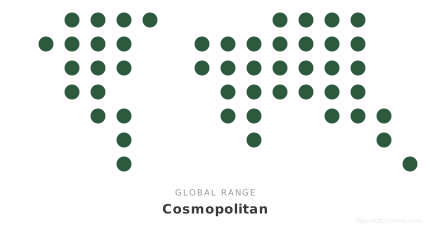
Whitish-green to bluish-gray above and black below, Parmelia sulcata is one of the most common lichens worldwide. Its upper surface is covered in a distinctive network of white, angular cracks (pseudocyphellae) filled with powdery soredia, giving it the “hammered” appearance that inspires its common name. The short, perpendicularly branched rhizines hold it closely appressed to bark.

One of the earliest colonizers on outer branches of oak, it serves as an intermediate nitrogen sensitivity indicator. Its ubiquity makes it an important baseline species for air quality monitoring studies across Europe and North America.
Common Greenshield
Flavoparmelia caperata
Foliose
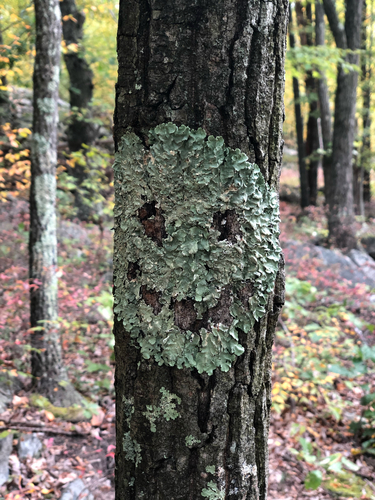
Photograph of Flavoparmelia caperata lichen in its natural habitat

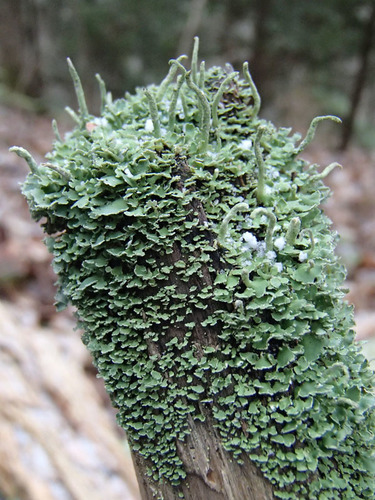
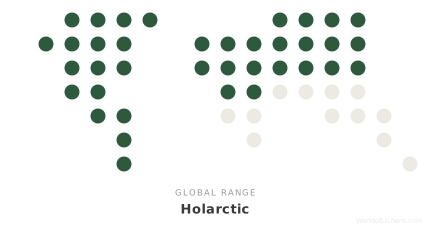
Unmistakable for its distinctive yellow-green colour, Flavoparmelia caperata is one of the most common foliose lichens in eastern North America. The wrinkled upper surface bears granular soredia, giving older specimens a rough, mealy texture. It grows loosely attached to the bark of deciduous trees, often forming broad rosettes.

Like Parmelia sulcata, it is an intermediate nitrogen indicator, present in moderately enriched environments but absent from the most polluted sites.
Common Orange Lichen
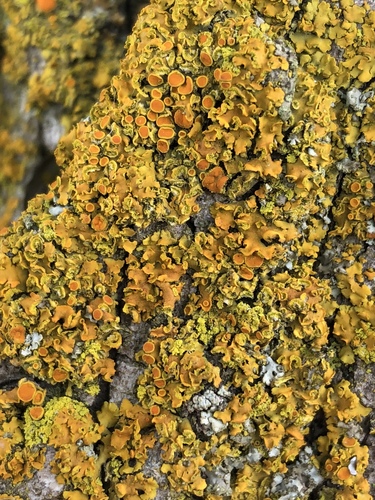
Xanthoria parietina
Foliose
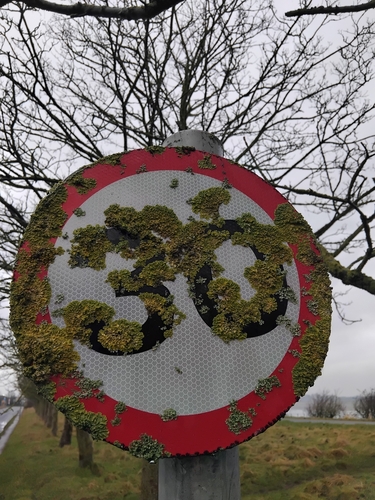
Photograph of Xanthoria parietina lichen in its natural habitat

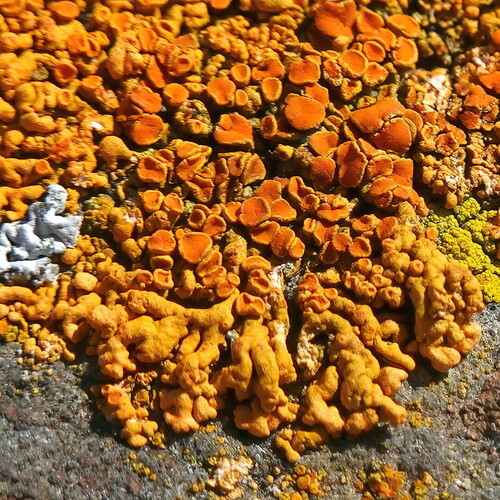
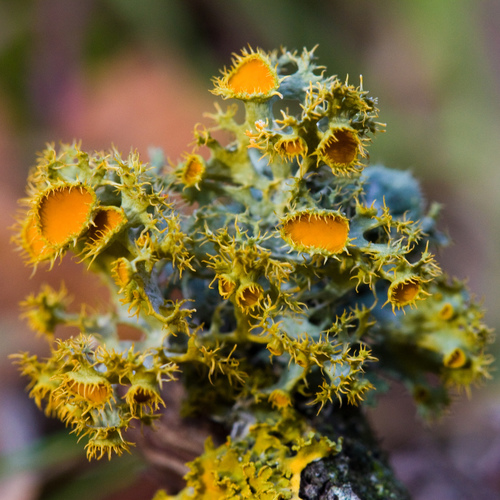
Bright orange to yellow-orange and impossible to overlook, Xanthoria parietina produces abundant orange apothecia and gets its vivid colour from anthraquinone pigments that act as a sunscreen. It thrives on bark, rock, and concrete, especially near coasts and farms where nitrogen enrichment is high.

Unlike most lichens that decline with pollution, X. parietina is a nitrogen-loving species that actually increases in enriched and polluted areas. It tolerates maritime salt spray and is often the dominant lichen on coastal structures and farm buildings.
Lung Lichen
Lobaria pulmonaria
Foliose
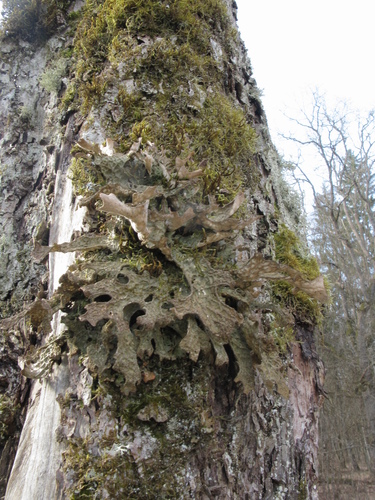
Photograph of Lobaria pulmonaria lichen in its natural habitat

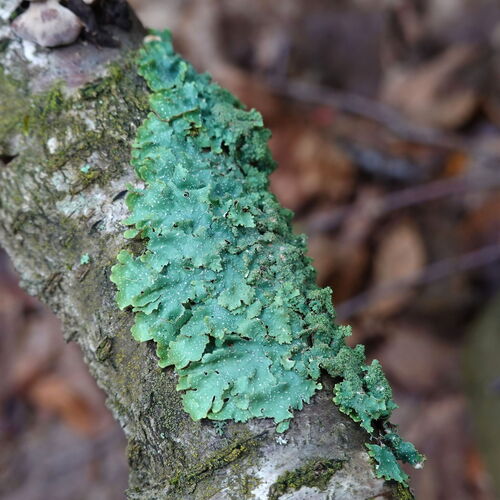
Green when moist and brownish when dry, Lobaria pulmonaria is a large, deeply ridged lichen whose surface texture resembles lung tissue — a resemblance that led medieval herbalists to prescribe it for respiratory ailments under the Doctrine of Signatures. Cephalodia on the lower surface house cyanobacteria that fix atmospheric nitrogen.

This tripartite lichen (fungus + green alga + cyanobacteria) is a prized indicator of old-growth forest continuity and clean air. It is declining across much of its range due to habitat loss and air pollution, and is legally protected in several European countries.
Textured Lungwort
Lobaria scrobiculata
Foliose
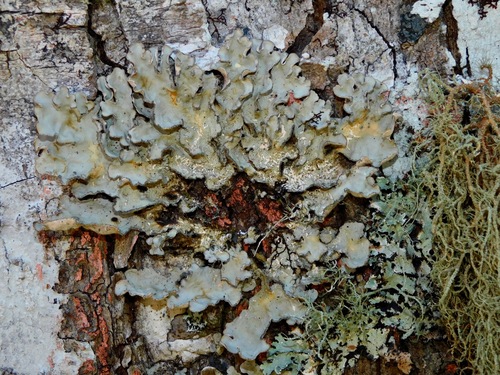
Photograph of Lobaria scrobiculata lichen in its natural habitat

Deep blue-gray when wet and lighter with a yellow tinge when dry, Lobaria scrobiculata features round soralia set among a loose network of ridges on its upper surface. The underside is cream to light brown and covered in a fine tomentum.

Found on the bark of hardwoods and shrubs in moist forests, it shares its larger cousin’s preference for clean, humid environments and old-growth conditions.
Membranous Dog Lichen
Peltigera membranacea
Foliose
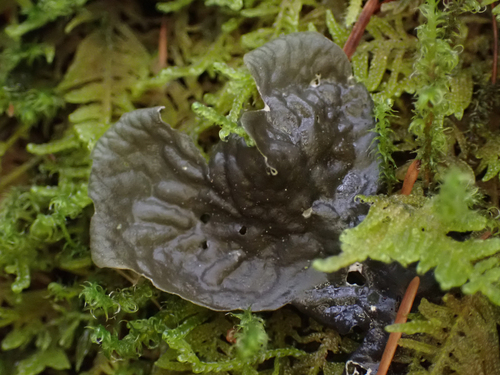
Photograph of Peltigera membranacea lichen in its natural habitat

A large, blue-green to brown-green lichen that sprawls over moss on the ground, logs, rocks, and tree bases in damp forests. The upper surface is weakly ridged with a fine tomentum, while tawny brown apothecia curl upward on raised lobe tips, sometimes likened to a dog’s tongue, hence the common name.

Turn it over and you will find one of its most distinctive features: a network of raised veins covered in velvety tomentum, anchored by long, unbranched rhizines. These veins help channel water across the lower surface.
Tree Pelt
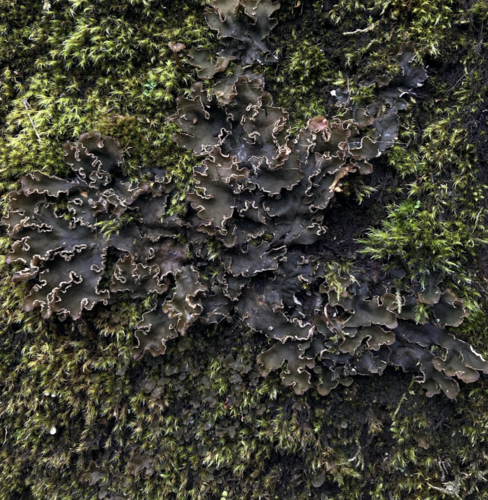
Peltigera collina
Foliose
Photograph of Peltigera collina lichen in its natural habitat

Brownish-green to grayish, Peltigera collina produces soredia along its lobe margins and brownish-black apothecia on raised lobe tips. The underside has brownish veins and variable rhizines that are often plumose (feathery).

Common on the bark of shrubs and hardwoods and often found growing over moss in moist forests, it is one of the more frequently encountered Peltigera species in temperate regions.
Black Stone Flower
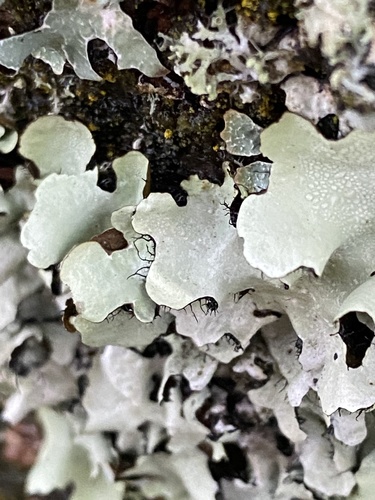
Parmotrema perlatum
Foliose
Photograph of Parmotrema perlatum lichen in its natural habitat

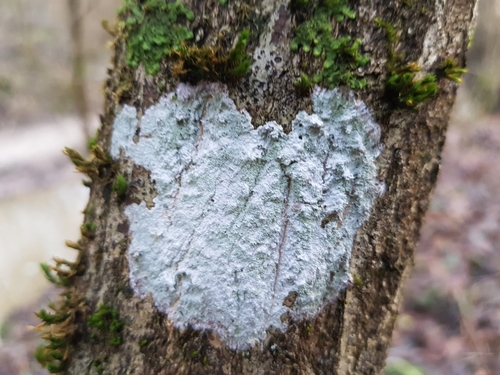
Bluish-white to greenish-gray and loosely attached to bark, Parmotrema perlatum has sparse black marginal cilia and small, crescent-shaped soralia near its lobe tips. The underside is black at the centre, becoming lighter toward the margins.

Fairly common in moist forests, it is used in traditional Indian cuisine as “kalpasi” or “dagad phool”, a spice valued for its earthy, musky aroma in meat dishes and biryanis.
Varied Rag Lichen
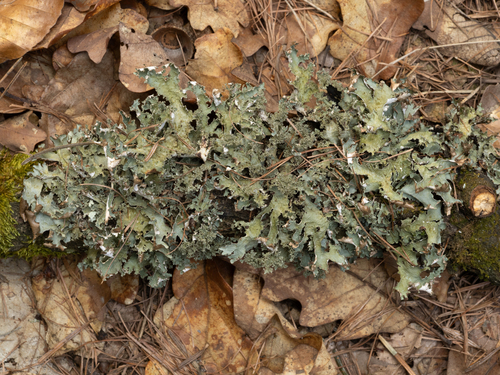
Platismatia glauca
Foliose
Photograph of Platismatia glauca lichen in its natural habitat

Grayish to pale green with a messy, tufted appearance, Platismatia glauca lacks the distinct network of ridges found in many foliose species. It may bear isidia, soredia, or both, and its underside is a patchy, variable mix of black, brown, and white.

Common on bark (especially conifers), it is frequently found on the forest floor after storms, torn from the canopy by wind and rain. Its ragged, somewhat dishevelled look makes it easy to recognize once you know what to look for.
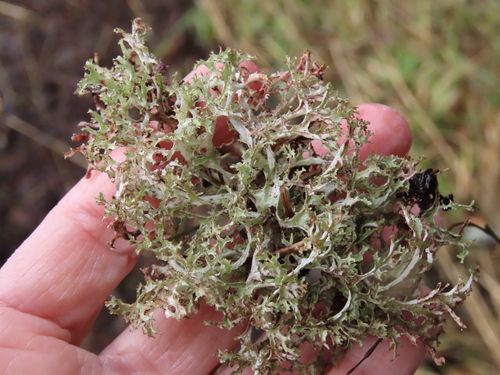
Tattered Rag Lichen
Platismatia herrei
Foliose
Photograph of Platismatia herrei lichen in its natural habitat

Similar to P. glauca but with narrower, longer lobes that occasionally droop from branches. Isidia line the lobe margins rather than the upper surface. Found on bark of conifers in moist forests, it adds to the draped, festooned character of old temperate rainforest canopies.
Rosette Lichens
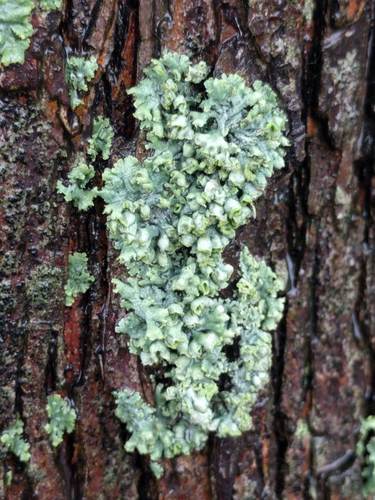
Physcia
Foliose
Photograph of Physcia lichen in its natural habitat

Gray above and distinctively white below, Physcia species form small, neat rosettes on bark. They often bear soredia or isidia at the lobe tips and are among the first lichens many beginners learn to recognize.

Nitrogen-tolerant and even nitrogen-loving, they thrive in nutrient-enriched environments where more sensitive species have vanished, making them useful markers of agricultural runoff and urban nitrogen deposition.
Fringed Kidney Lichen
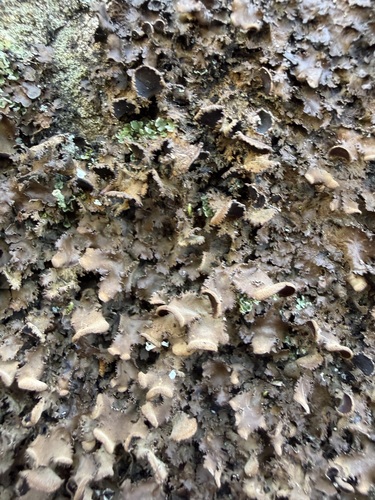
Nephroma helveticum
Foliose
Photograph of Nephroma helveticum lichen in its natural habitat

Brownish-green to bluish-brown, Nephroma helveticum is a low-growing lichen with smooth lobes decorated by many marginal and laminal lobules. Its most unusual feature is the placement of its orange-brown apothecia: they appear on the underside of the lobe tips, visible only when the lobes curl upward.

Found on the bark of shrubs and hardwoods, often over moss, it is an indicator of moist, mature forest conditions.
Monk’s Hood Lichen
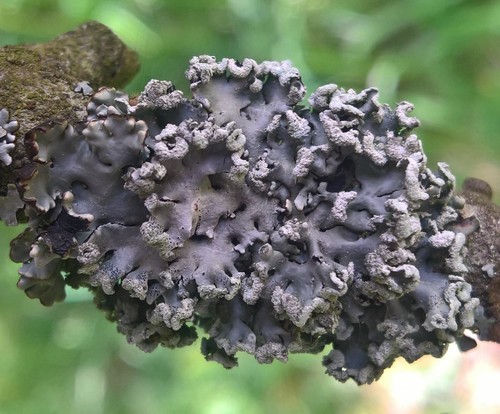
Hypogymnia physodes
Foliose
Photograph of Hypogymnia physodes lichen in its natural habitat

Gray-green above with a distinctive black, shiny underside, Hypogymnia physodes has inflated, hollow lobes that burst open at the tips to reveal powdery soredia inside, one of its key identification features. Unlike most foliose lichens, it lacks rhizines entirely and attaches to its substrate by a holdfast or simply by lying against bark.

Widespread and common across the Northern Hemisphere on tree bark and occasionally on rock, it is one of the most frequently used lichens in air quality biomonitoring studies. Its tolerance range sits between the most sensitive species and the hardiest nitrogen-lovers, making it a useful middle-of-the-road indicator.
Fruticose Lichens

Three-dimensional, shrubby, or pendant lichens that hang from branches, stand upright on soil, or form tangled mats across the forest floor. Fruticose lichens have no distinct upper and lower surface ; photosynthesis can occur from all sides. They are often the most pollution-sensitive group and among the first to disappear from degraded environments.

Old Man’s Beard
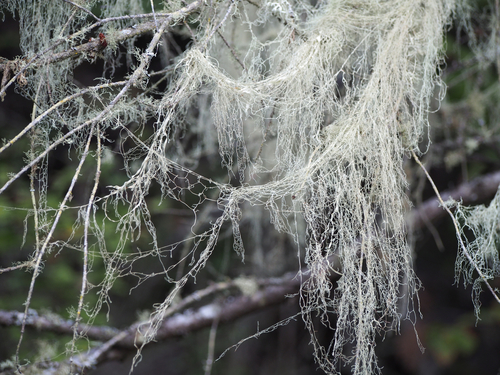
Usnea
Fruticose
Photograph of Usnea lichen in its natural habitat

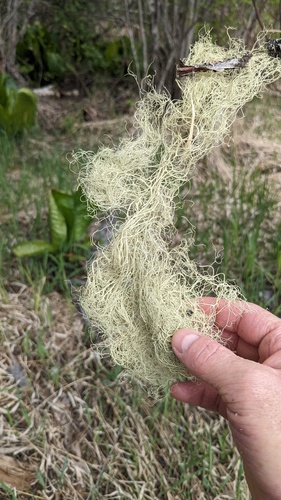
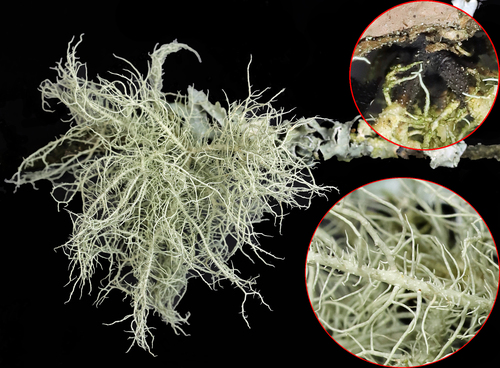
Pale green to gray-green and hanging in wispy strands from tree branches, Usnea species are among the most iconic of all lichens. Multiple species exist: U. longissima can reach several feet in length, while U. hirta and U. dasopoga form shorter tufts.

Extremely sensitive to air pollution, Usnea species vanish from areas with elevated sulphur dioxide and are reliable indicators of clean air. They produce usnic acid, a compound with demonstrated antibiotic properties effective against Gram-positive bacteria.

The diagnostic test for Usnea: gently pull a strand apart. The outer cortex will snap, but a white, elastic central cord stretches between the two halves. No other hanging lichen has this cord. If there is no cord, you are holding Bryoria.
Oakmoss
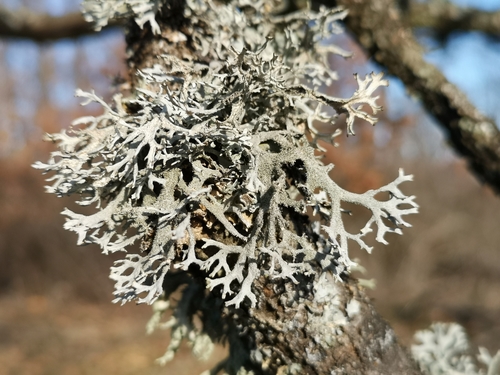
Evernia prunastri
Fruticose
Photograph of Evernia prunastri lichen in its natural habitat

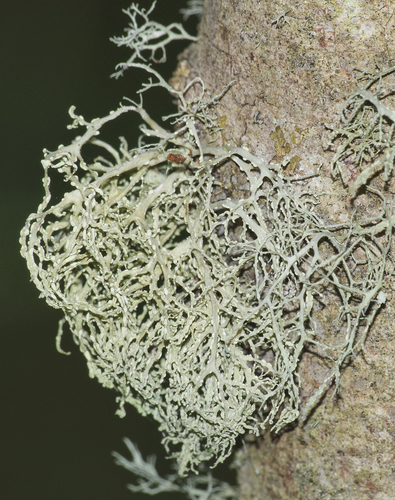
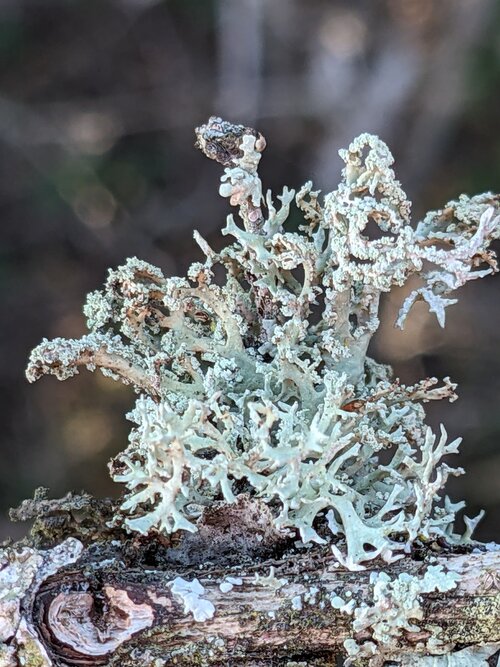
Gray-green above and white below, with flattened, antler-like branching, Evernia prunastri is one of the most economically valuable lichens in the world. Its distinct two-toned colouring (darker on top, pale beneath) distinguishes it from other fruticose species at a glance.

The perfume industry harvests tonnes of oakmoss annually from oak forests in southern France and the Balkans. The extracted compounds provide a deep, earthy base note used in classic perfumes like Chanel No. 5 and Dior’s Miss Dior. It is a nitrogen-sensitive indicator species.

British Soldiers
Cladonia cristatella
Fruticose
Photograph of Cladonia cristatella lichen in its natural habitat

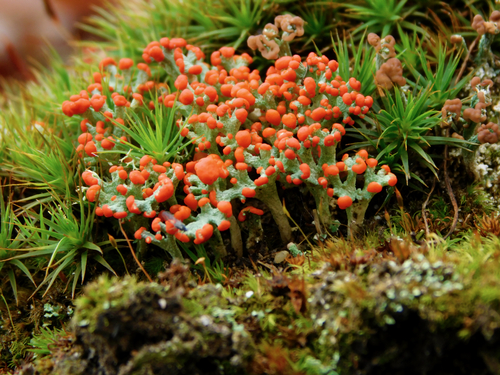
Gray-green squamules topped by short podetia bearing scarlet red caps — Cladonia cristatella is one of the most recognizable and beloved lichens in North America. The bright red apothecia are impossible to miss against the dull greens of rotting wood and stumps where it grows.

Named for the red-coated British soldiers of the American Revolution, it is often the first lichen that sparks a lifelong interest in lichenology. The red pigment is rhodocladonic acid.

Reindeer Lichen
Cladonia rangiferina
Fruticose
Photograph of Cladonia rangiferina lichen in its natural habitat

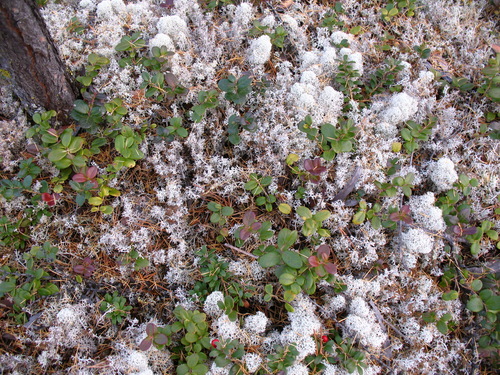
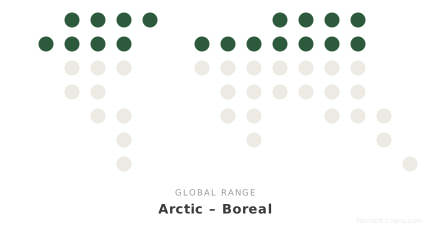
Silvery gray to gray-green, highly branched and coral-like, Cladonia rangiferina forms dense mats across the ground in boreal and arctic regions. It produces no cups; instead, its branch tips all curve in one direction, a useful identification feature in the field.

This is the primary winter food source for caribou and reindeer, who dig through snow to reach it. A single caribou may consume 2–5 kg per day. Reindeer lichen grows just 3–5 mm per year, meaning overgrazed areas can take decades to recover, a growing concern as climate change alters snow conditions and grazing patterns in the Arctic.

Pixie Cups
Cladonia pyxidata
Fruticose
Photograph of Cladonia pyxidata lichen in its natural habitat

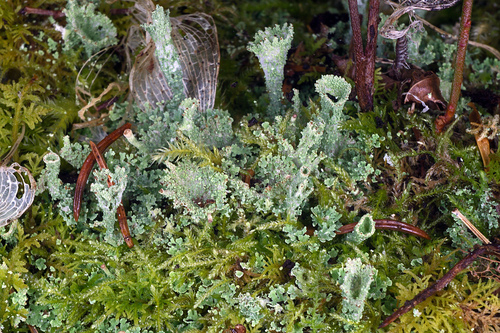
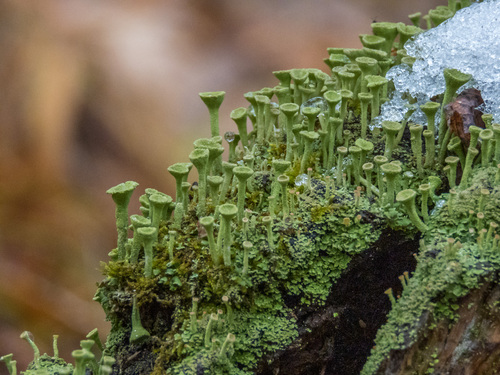
Gray-green with charming cup-shaped podetia — tiny goblets rising from a bed of basal squamules. The scaly cup surfaces of Cladonia pyxidata (pebbled pixie-cup) and the closely related C. chlorophaea (mealy pixie-cup, with soredia lining the cup interior) are a perennial favourite of naturalists and photographers.

Found on soil, rotting wood, and mossy stumps, the cups function as splash dispersal structures: rain drops striking the cup fling soredia outward to colonize new territory.

Trumpet Lichen
Cladonia fimbriata
Fruticose
Photograph of Cladonia fimbriata lichen in its natural habitat

Closely related to the pixie cups, Cladonia fimbriata produces slender, trumpet-shaped podetia that flare into neat, well-defined cups. The podetia are covered in a farinose (mealy) sorediate coating, giving them a powdery, frosted look.

Common on soil, rotting wood, and tree bases, it often grows alongside other Cladonia species, creating miniature landscapes of cups, trumpets, and tiny scarlet-capped soldiers.

Horsehair Lichens
Bryoria
Fruticose
Photograph of Bryoria lichen in its natural habitat

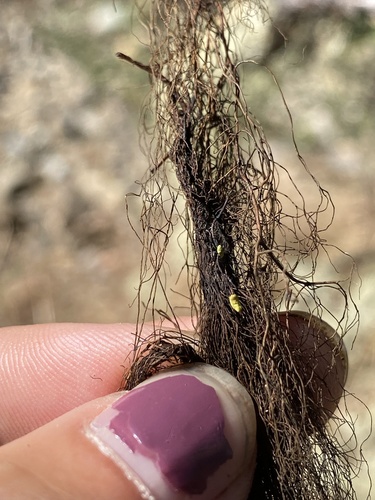
Dark brown to nearly black, pendant and hair-like, Bryoria species drape from conifer branches in long, dark curtains. The critical identification point: no central cord. Pull a strand apart, and it simply snaps cleanly, unlike Usnea, which reveals its stretchy white core.

Multiple species exist, including B. fremontii, which was a major traditional food source for Indigenous peoples of western North America, pit-cooked for days into a dark, nutritious bread. B. capillaris and B. fuscescens are common but not eaten.

Witches Hair
Alectoria
Fruticose
Photograph of Alectoria lichen in its natural habitat

Pale yellow-green to dark, with hair-like strands that often show angular branching, Alectoria has a different texture from Bryoria despite a superficially similar growth habit. Species include A. sarmentosa (witches hair), A. imshaugii, and A. vancouverensis.

Found on conifer branches in montane and boreal forests, these lichens contribute to the “old forest” aesthetic and provide important nesting material for birds.

Strap Lichens
Ramalina
Fruticose
Photograph of Ramalina lichen in its natural habitat

Yellow-green with flattened, strap-like branches (never round in cross-section), Ramalina species often bear soredia on their surfaces. R. farinacea is one of the most common species, found across Europe and North America.

Preferring well-lit bark habitats, Ramalina is frequently found on exposed trees at forest edges and in open woodlands. Its flattened branches distinguish it from the round-stemmed Usnea and dark, thread-like Bryoria.

Gelatinous Lichens

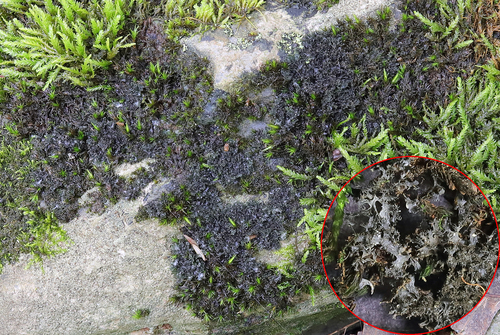
Perhaps the most dramatic shape-shifters in the lichen world. When dry, gelatinous lichens are dark, brittle, and easily overlooked. Add water, and they swell into translucent, rubbery forms that look nothing like their desiccated selves. All have cyanobacterial photobionts (typically Nostoc) distributed throughout the thallus rather than in a distinct layer, and all are nitrogen fixers.

Jellyskin Lichens
Leptogium
Gelatinous
Photograph of Leptogium lichen in its natural habitat

Dark gray-blue to black when dry, Leptogium species swell and become translucent blue-gray when wet, revealing their gelatinous internal structure. The cyanobacterial photobiont Nostoc gives them their dark colouration and nitrogen-fixing ability.

Found on bark and rock in moist environments, they play an important ecological role by contributing fixed nitrogen to forest nutrient cycles. Their dramatic transformation with moisture makes them fascinating to observe after rain.

Antlered Jellyskin
Scytinium palmatum
Gelatinous
Photograph of Scytinium palmatum lichen in its natural habitat

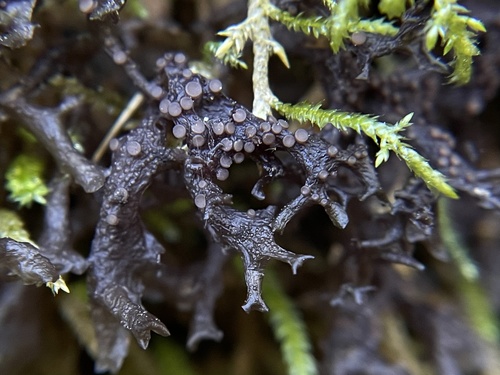
Dark brownish-black and somewhat erect, Scytinium palmatum is a many-lobed gelatinous lichen with inrolled and pointed margins that give it an antler-like profile. The surface is sharply wrinkled, and raised brown apothecia are common.

Growing on soil, rock, moss over rock or bark, and mossy tree trunks, it is one of the more structurally complex gelatinous lichens: its erect, branching lobes rising above the substrate rather than lying flat.

Jelly Lichens
Collema
Gelatinous
Photograph of Collema lichen in its natural habitat

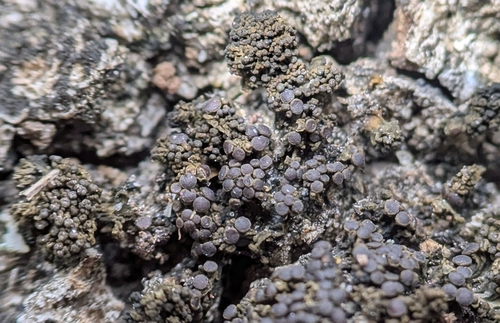
Dark olive to black, Collema species are truly gelatinous through and through: they have no internal layering at all. Cyanobacteria are distributed throughout the entire thallus rather than being confined to a photobiont layer, giving the whole body a uniform, jelly-like consistency when wet.

Several species exist, including C. nigrescens, C. furfuraceum, C. subflaccidum, and C. curtisporum, found on both bark and rock. Their complete lack of internal structure distinguishes them from Leptogium, which has a thin cortex.

Crustose Lichens

Paint-like crusts fused directly to their substrate (rock, bark, or soil) with no lower cortex or means of detachment. Crustose lichens cannot be removed without taking a piece of whatever they grow on. They include some of the oldest living organisms on Earth and are the dominant lichen group on rock surfaces worldwide.

Map Lichen
Rhizocarpon geographicum
Crustose
Photograph of Rhizocarpon geographicum lichen in its natural habitat

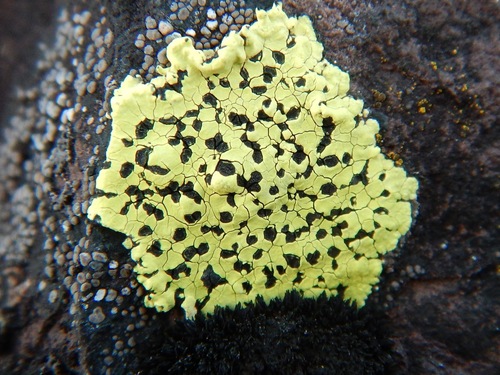
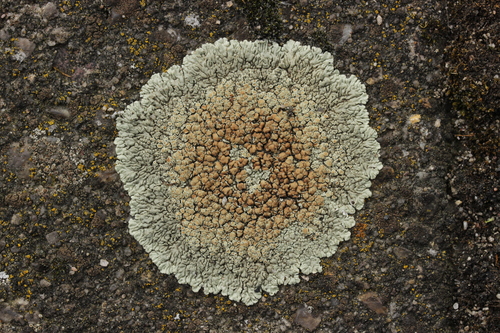
Bright yellow-green areoles bordered by bold black lines, creating a striking pattern that resembles a map or aerial photograph of cultivated fields — Rhizocarpon geographicum is unmistakable. Found on siliceous rock in alpine and arctic environments, it is incredibly slow-growing, adding as little as 0.5 mm per year.

Individual specimens have been dated to over 8,600 years old, making map lichen among the oldest living organisms on Earth. This extreme longevity and predictable growth rate make it the cornerstone of lichenometry, a technique used by geologists to date rock surfaces, glacial moraines, and stone structures by measuring the diameter of the largest Rhizocarpon thallus present.

Script Lichen
Graphis scripta
Crustose
Photograph of Graphis scripta lichen in its natural habitat

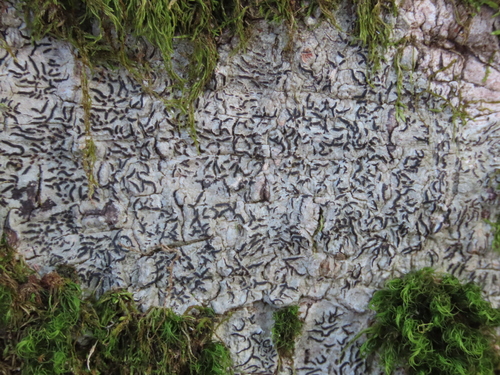
Smooth gray-white with thin, dark, line-like fruiting bodies called lirellae that twist and branch across its surface like cursive handwriting — Graphis scripta looks as though someone has written on the bark in an unknown alphabet. The name itself means “written script.”

Found on the smooth bark of young trees, it is a common and widespread crustose species that delights observers once they learn to spot it. Each lirella is an elongated apothecium, a spore-producing structure stretched into a line rather than the usual disc shape.

Continue Reading

Next: Uses & Facts →