Overview
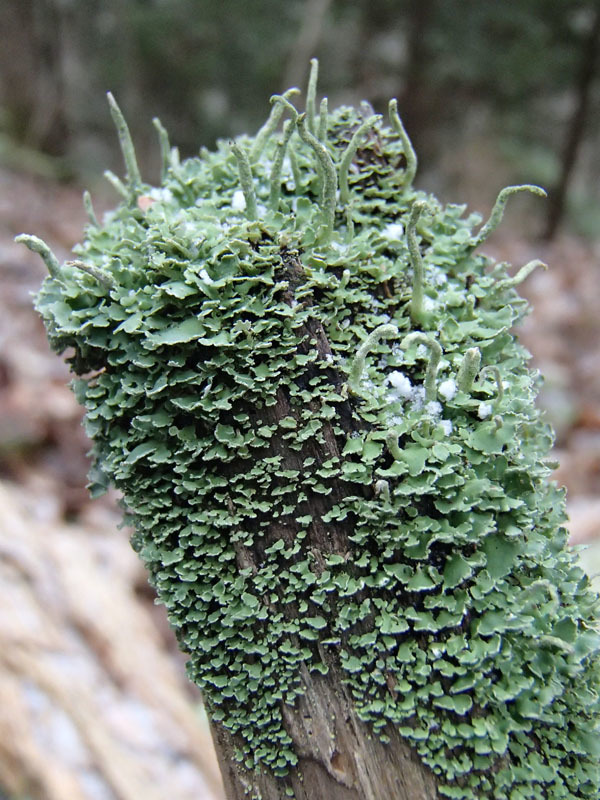
Slender, pointed podetia (stalks) rising 1–3 cm from a basal mat of squamules, Cladonia coniocraea is one of the most abundant Cladonia species in temperate forests. The podetia are simple, unbranched, and taper to a fine point covered in farinose soredia.
Found on rotting logs, tree stumps, and the bases of living trees, it is a characteristic species of damp, shaded woodland. Unlike the cup-bearing Cladonia species, its podetia never form cups or branches.
Often overlooked due to its small size and dull gray-green colour, it plays an important role in nutrient cycling on decaying wood.
Identification
- Slender, pointed podetia (1–3 cm tall) that taper gradually without forming cups.
- Entirely covered in fine, farinose (powdery) soredia, especially toward the tips.
- Gray-green colour; basal squamules are small and often inconspicuous.
- Always on rotting wood, peat, or bark at the base of trees.
- Distinguished from C. fimbriata by the absence of cups and finer soredia.
Ecology & Habitat
A pioneer on decaying wood in forests. Often the first lichen to colonize freshly exposed rotting wood on stumps and fallen logs. Common in the understory of both deciduous and coniferous woodland, favouring humid, shaded conditions.
Fun Facts
It is arguably the single most common Cladonia species in the temperate world, found on virtually every rotting log in moist woodland.
The pointed podetia act like tiny chimneys — soredia are released from the tips, catching air currents above the still boundary layer near the ground.
It was one of the first lichens shown to have distinct chemotypes — populations that look identical but produce different chemical compounds, hinting at cryptic species.
Despite its abundance, it contributes meaningfully to forest nutrient cycles by breaking down dead wood and making minerals available to growing trees.
Distribution
Cosmopolitan; found throughout temperate and boreal regions worldwide