Overview
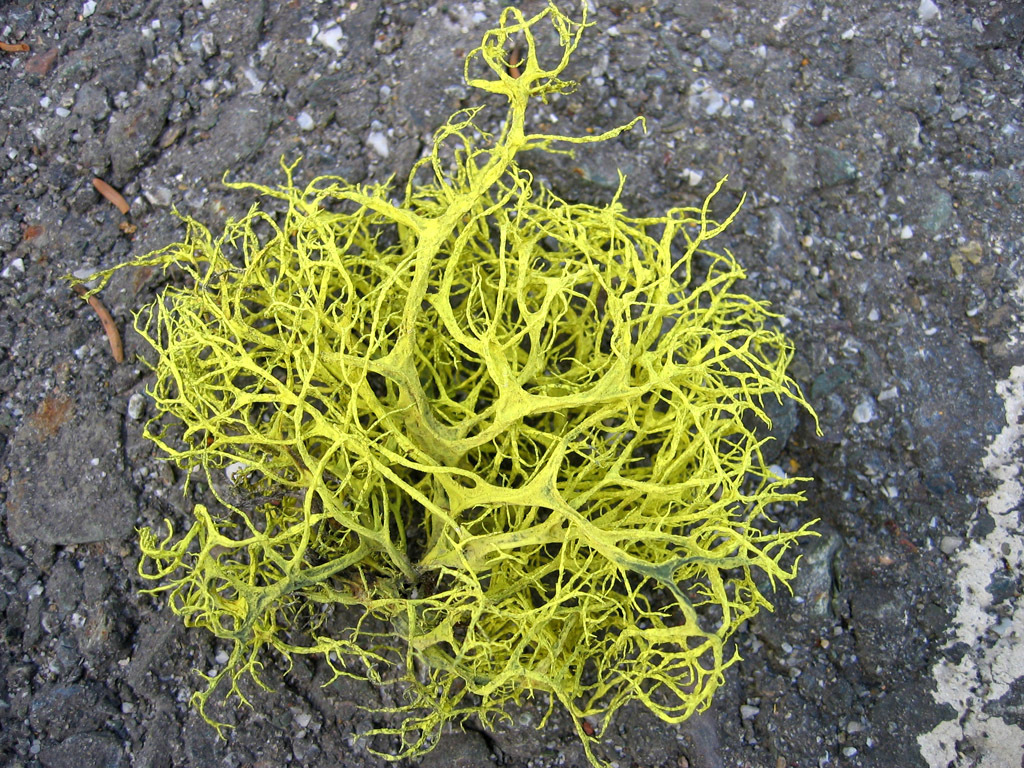
Brilliant chartreuse-yellow and impossible to miss, Letharia vulpina is one of the most visually striking lichens in western North American forests. It forms shrubby, irregularly branched tufts 3–15 cm long on conifer bark and dead wood.
The intense yellow-green colour comes from vulpinic acid, a toxic compound historically used as a wolf and fox poison — the basis of both its common and scientific names ("letharia" from lethal, "vulpina" from fox).
Common and conspicuous in montane forests from the Rockies to the Pacific Coast, it is a signature species of western mountain landscapes and is easily spotted from a distance due to its electric colour.
Identification
- Brilliant chartreuse-yellow to yellow-green colour; unmistakable.
- Shrubby, irregularly branched tufts (3–15 cm) on conifer bark or dead wood.
- Soredia are present on some forms; apothecia are extremely rare.
- Found almost exclusively on conifers at montane to subalpine elevations.
- The closely related L. columbiana has a paler, more olive colour and different chemistry.
Ecology & Habitat
Common on pines, firs, and larches in open montane forests above 1000 m elevation in western North America. Prefers well-lit, continental climates with cold winters. Often abundant on dead standing wood (snags) and fence posts. Sensitive to humid maritime climates.
Fun Facts
Scandinavian and Native American peoples used it to poison wolves and foxes by stuffing it into bait carcasses. The vulpinic acid is toxic to mammals but the lichen is not toxic on contact.
Despite its toxicity to mammals, it was used by several Indigenous groups as a yellow dye for textiles and decorative items, producing a bright, lightfast colour.
It is one of the few lichens recognizable from a moving car — its electric chartreuse colour stands out dramatically against dark conifer bark.
Molecular work has revealed that what was called L. vulpina actually contains two species: the sorediate L. vulpina and the non-sorediate L. columbiana, which rarely produces apothecia.
Old-growth forests in the Pacific Northwest can support biomass of over 100 kg of Letharia per hectare, making it one of the most abundant epiphytic lichens by weight.
Distribution
Western North America (Rocky Mountains to Pacific Coast) and mountains of Europe