Overview
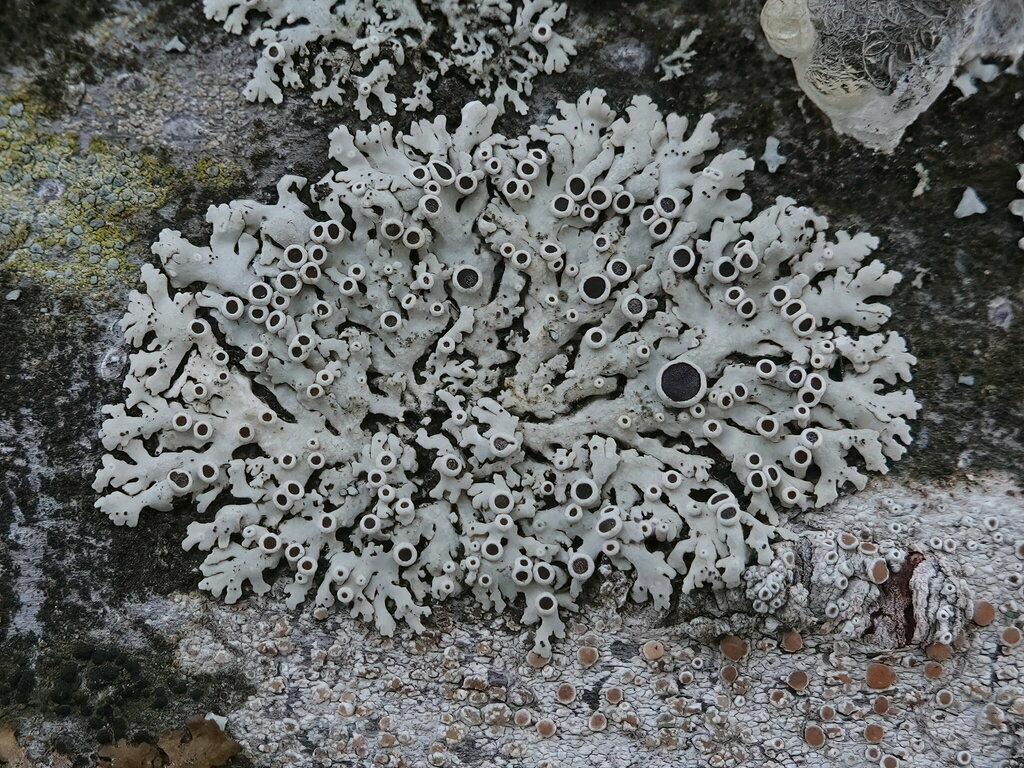
Pale gray to white with narrow, radiating lobes forming neat star-shaped rosettes, Physcia stellaris is a small but common lichen on deciduous tree bark. It frequently produces dark brown to black apothecia with a conspicuous white rim.
Unlike the sorediate Physcia species, P. stellaris reproduces sexually via apothecia and lacks soredia entirely. The upper cortex is pale gray and the undersurface is white to pale with simple rhizines.
One of several Physcia species common on urban trees, it is often found alongside P. adscendens and Xanthoria parietina.
Identification
- Small, neat rosettes (1–5 cm) with narrow, radiating lobes.
- Pale gray to white upper surface; white underside with pale rhizines.
- Abundant dark brown to black apothecia with a white thalline margin.
- No soredia (distinguishes it from P. adscendens and P. tenella).
- K+ yellow on medulla (atranorin).
Ecology & Habitat
Common on well-lit bark of deciduous trees in urban parks, along roads, and at forest edges. Moderately pollution-tolerant and nitrogen-tolerant. Often one of the first foliose lichens to colonize young trees in parks and gardens.
Fun Facts
The "stellaris" name means star-like, referring to the neat radiating pattern of its lobes that makes each thallus look like a tiny gray star on the bark.
It is one of the few common foliose lichens that reproduces primarily by sexual spores rather than vegetative fragments — most of its relatives in the genus rely on soredia instead.
Each tiny apothecium produces millions of microscopic spores, but only a vanishingly small fraction land on suitable bark and encounter the right algal partner to form a new lichen.
In urban ecology studies, the ratio of P. stellaris to more sensitive species is used as a quick indicator of nitrogen enrichment levels on street trees.
Distribution
Cosmopolitan; widespread in temperate regions of both hemispheres