Overview
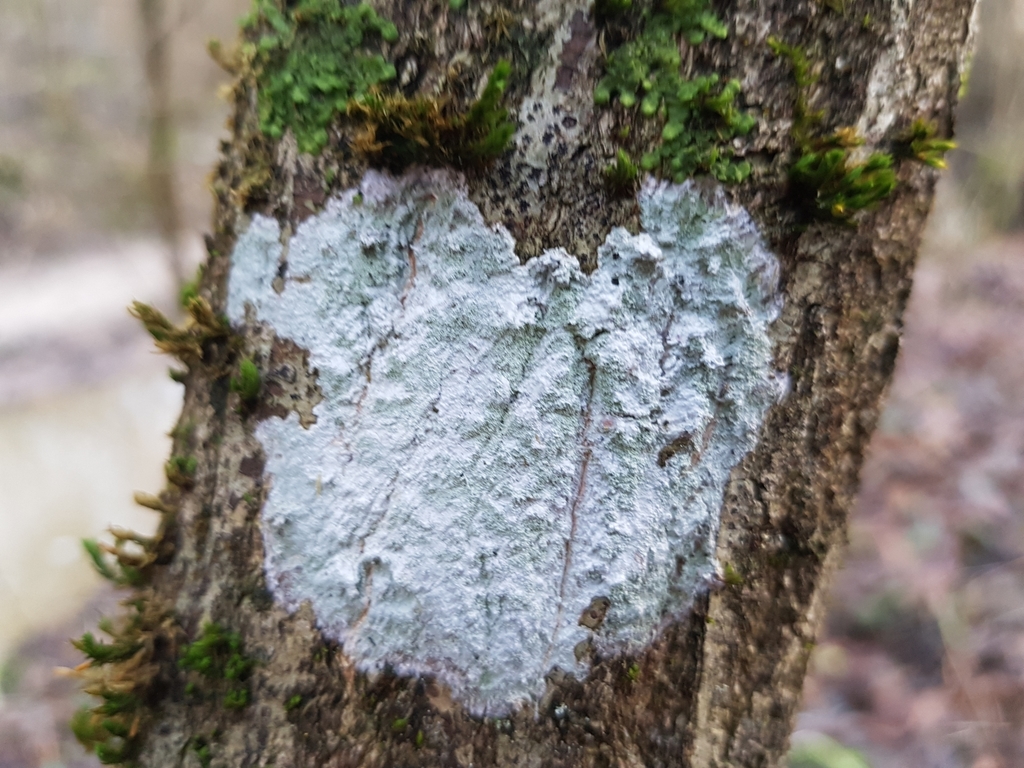
A smooth, white to pale gray crust that looks as though someone has painted whitewash onto bark, Phlyctis argena is one of the most common yet overlooked lichens in deciduous woodland. Its thallus forms a thin, continuous film on shaded bark.
The white soralia are scattered across the surface, producing powdery soredia for vegetative reproduction. Fruiting bodies (apothecia) are rarely produced, making this predominantly a clonal species.
Though superficially unexciting, it is an important component of the bark lichen community and often one of the first species to colonize the shaded sides of tree trunks.
Identification
- Thin, smooth, white to pale gray crust on bark; looks like spilled whitewash or paint.
- Scattered white soralia producing powdery soredia.
- C+ red reaction (gyrophoric acid) distinguishes it from similar white crusts.
- Almost always on the shaded north-facing side of trees.
- Apothecia very rare; if present, they are pale with a thin margin.
Ecology & Habitat
Prefers the shaded, humid side of mature deciduous trees. Common in closed-canopy woodland and old hedgerows. Often found alongside Graphis scripta and Lepraria species on smooth bark in the understorey.
Fun Facts
The name "argena" means silvery , referring to its bright white appearance that catches the eye even in dim woodland light.
It is a champion of shade tolerance . While most lichens need direct sunlight, this species thrives on the darkest side of tree trunks where competition from other lichens is minimal.
Its C+ red spot test (producing a vivid crimson colour with bleach) is one of the most dramatic and satisfying chemical reactions in field lichenology.
Despite being extremely common, it almost never produces sexual fruiting bodies, relying instead on vegetative soredia for dispersal — a strategy that limits genetic diversity but maximizes local colonization speed.
Distribution
Widespread across Europe and eastern North America; also found in East Asia