Overview
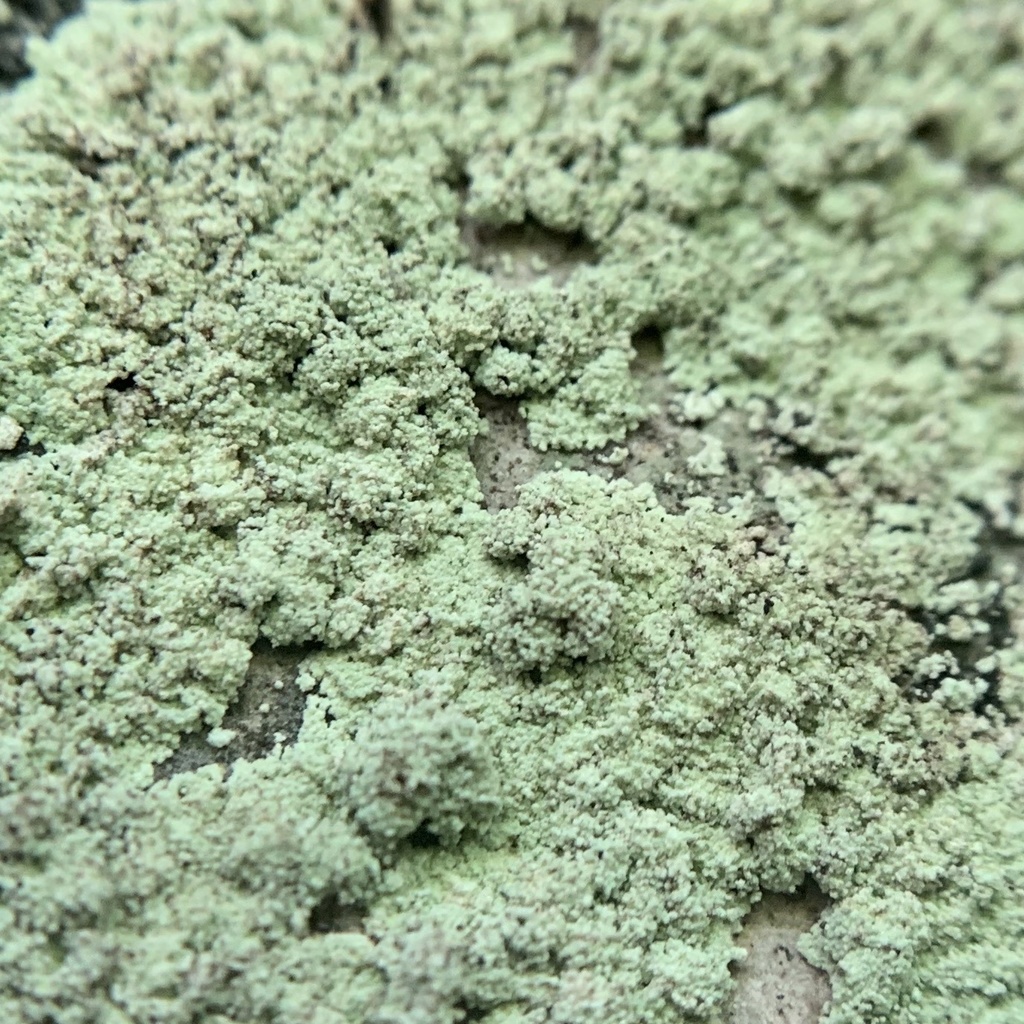
A soft, powdery, blue-gray to greenish-gray crust with no defined margins or visible structure, Lepraria finkii is the quintessential leprose lichen — composed entirely of loose, powdery granules (soredia) with no cortex, no fruiting bodies, and no recognizable thallus.
Found in the most deeply shaded habitats where no other lichen grows — rock overhangs, cave entrances, deep crevices, and the undersides of leaning trees — it represents the extreme end of shade adaptation.
Often dismissed as 'just dust' by beginners, the genus Lepraria has proven surprisingly species-rich under molecular analysis, with dozens of cryptic species hiding under similar morphologies.
Identification
- Entirely powdery (leprose) with no cortex or defined thallus structure.
- Blue-gray to greenish-gray colour; soft and fluffy in texture.
- No apothecia, pycnidia, or any reproductive structures ever produced.
- Found in deeply shaded, sheltered positions: overhangs, crevices, shaded bark.
- KC+ purple or P+ orange reactions help distinguish from other Lepraria species.
Ecology & Habitat
Occupies the most light-limited niches available to lichens. Found on substrates that receive almost no direct light — cave mouths, north-facing overhangs, deep bark crevices. Requires stable humidity and shelter from rain wash.
Fun Facts
It is the lichen that grows where no lichen should . Cave entrances, the undersides of boulders, and the deepest bark crevices are its domain.
It has completely abandoned sexual reproduction . With no cortex, no fruiting bodies, and a body made entirely of loose soredia, it reproduces only by fragmentation — tiny pieces blowing to new surfaces.
Molecular studies have revealed that what was once called 'Lepraria incana' is actually a complex of 20+ cryptic species, distinguishable only by chemistry and DNA. L. finkii is one of the most common segregates in North America.
The genus name comes from the Latin "lepra" (scaly), and early lichenologists debated whether these powdery crusts were true lichens at all — some thought they were just algae with a bit of fungus.
Distribution
Cosmopolitan; found throughout temperate regions of North America, Europe, and Asia