Overview
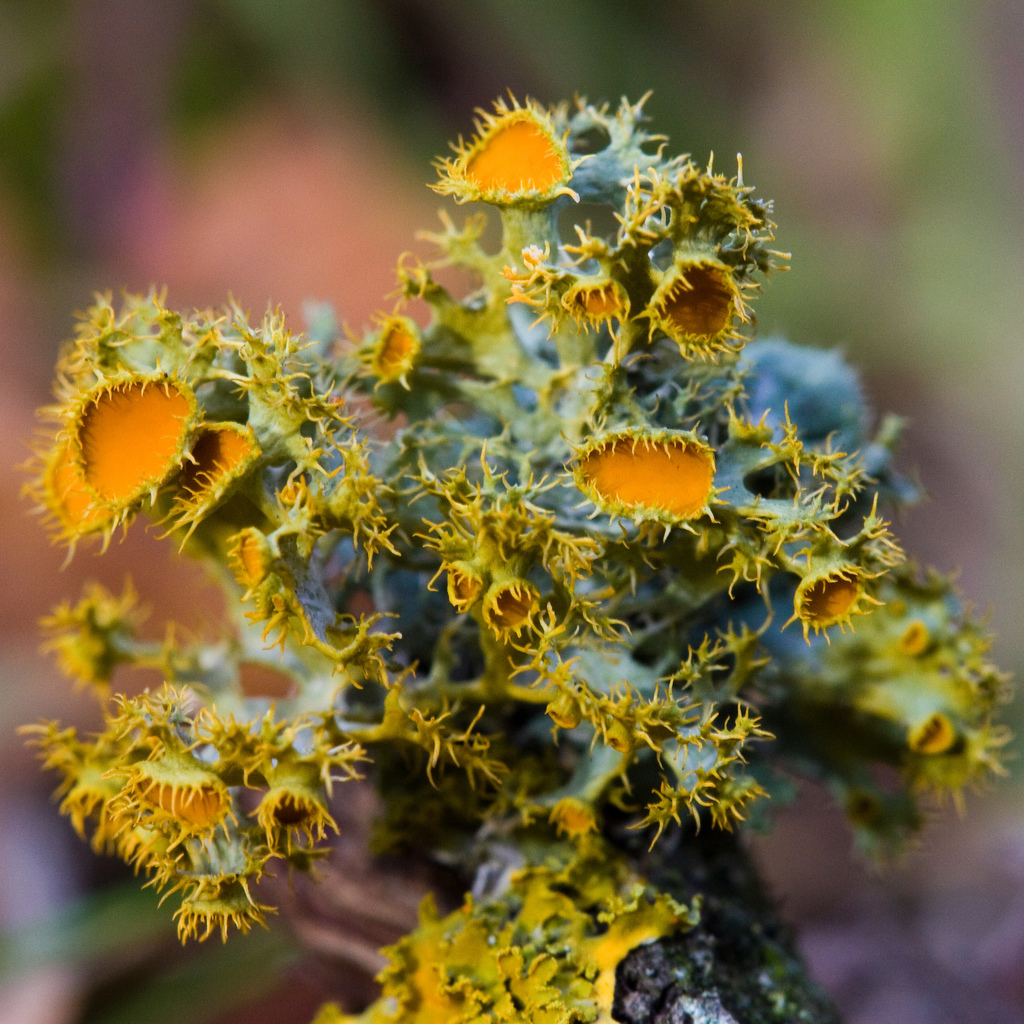
A small, bright orange, tufted lichen with conspicuous orange apothecia rimmed with delicate eyelash-like cilia, Teloschistes chrysophthalmus is one of the most beautiful and sought-after lichens in temperate regions. The name means "golden eye," referring to the fringed apothecia.
Unlike the crustose or foliose orange lichens (Xanthoria, Rusavskia), this species is truly fruticose — forming small shrubby tufts 1–3 cm across on bark and twigs.
Once widespread across Europe, it declined dramatically in the 20th century due to air pollution and is now a conservation priority in several countries. In North America and the Southern Hemisphere, it remains more common.
Identification
- Bright orange, shrubby tufts (1–3 cm) on bark or twigs.
- Apothecia are the key feature: orange discs fringed with hair-like cilia (the "eyelashes").
- Branches are flattened to slightly rounded, with a fibrous medulla visible when broken.
- K+ purple reaction confirms anthraquinone pigments.
- Distinguished from Xanthoria by its fruticose (shrubby) growth form.
Ecology & Habitat
Grows on well-lit bark and twigs in warm-temperate to subtropical regions. Sensitive to sulphur dioxide and has declined across much of Europe. Prefers coastal and maritime climates with clean air. In recovery in some areas where pollution has decreased.
Fun Facts
The "golden eye" name refers to its fringed apothecia — the cilia around each disc look like golden eyelashes, making it one of the most aesthetically striking lichens under a hand lens.
In England, it went from common to nearly extinct during the 20th century due to air pollution. Its reappearance in southern England in recent decades is celebrated as a sign of clean air recovery.
It is the only widespread orange fruticose lichen in temperate regions, making it unmistakable in the field once you know what to look for.
Despite being tiny (rarely more than 3 cm), each thallus may be decades old — it grows extremely slowly and depends on long-term habitat stability.
Australian populations of Teloschistes include some of the most spectacular species in the genus, with large tufts covering entire branches.
Distribution
Widespread but patchy; found in coastal and warm-temperate regions across multiple continents