Overview
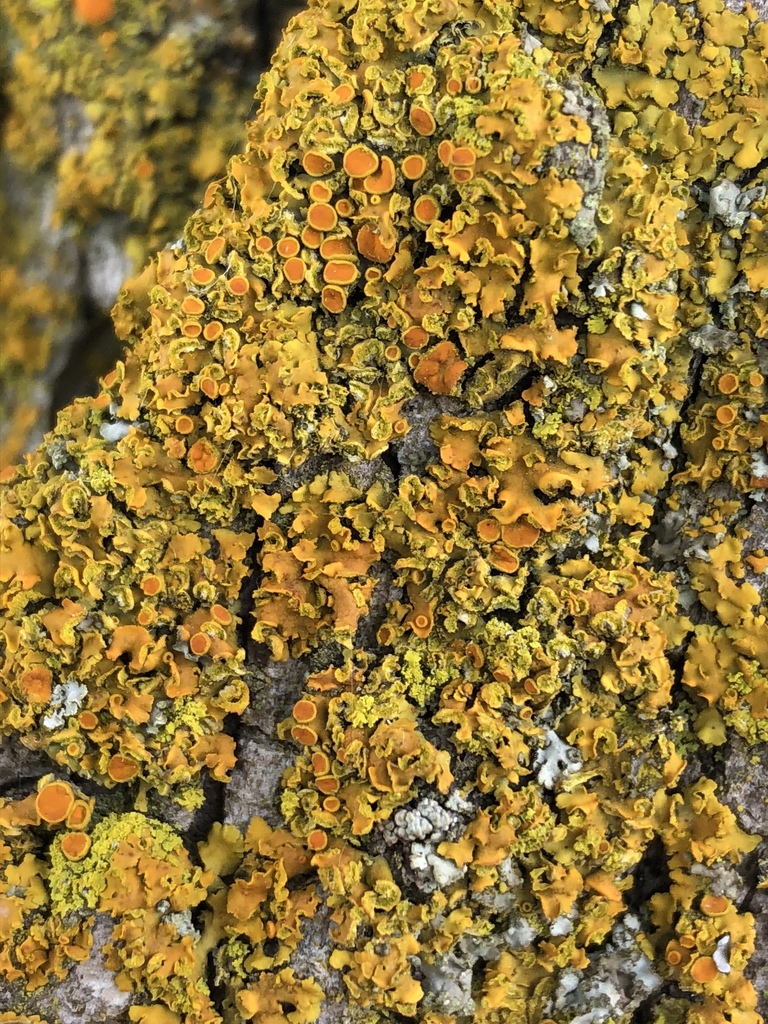
Small, bright orange to yellow-orange with distinctive hood-shaped soralia at the lobe tips, Xanthomendoza fallax is a common nitrogen-loving lichen on deciduous trees. It forms small rosettes or scattered lobes 1–3 cm across.
The hood-shaped (helmet-shaped) soralia at the lobe tips are diagnostic — the lobe curls over to form a hood beneath which soredia accumulate. This feature distinguishes it from Xanthoria parietina, which produces apothecia rather than soredia.
One of several small orange lichens common on urban and suburban trees, it is often found alongside Xanthoria parietina and Physcia species.
Identification
- Small (1–3 cm), orange to yellow-orange rosettes or scattered lobes on bark.
- Distinctive hood-shaped soralia at the lobe tips — lobes curl over to form a hood.
- Smaller and more delicate than Xanthoria parietina.
- Apothecia rare (unlike X. parietina which is usually fertile).
- K+ purple reaction on cortex (anthraquinone pigments).
Ecology & Habitat
A nitrophile that thrives on nutrient-enriched bark, especially near farms, bird perches, and in urban areas. Often found on the same trees as Xanthoria parietina but typically on younger twigs and outer branches. Increasing in abundance with nitrogen deposition.
Fun Facts
The species name "fallax" means deceptive — it was long confused with Xanthoria candelaria and other small orange species before being recognized as distinct.
The hood-shaped soralia are a beautiful adaptation: the curled lobe protects the delicate soredia from rain wash while still allowing wind dispersal.
It is one of several orange lichens that have increased dramatically in abundance over the past century as atmospheric nitrogen deposition has risen from agriculture and vehicle emissions.
Together with Xanthoria parietina and Physcia adscendens, it forms the classic "nitrogen-loving" lichen community that dominates enriched urban trees.
Distribution
North America and Europe; common in temperate regions