Overview
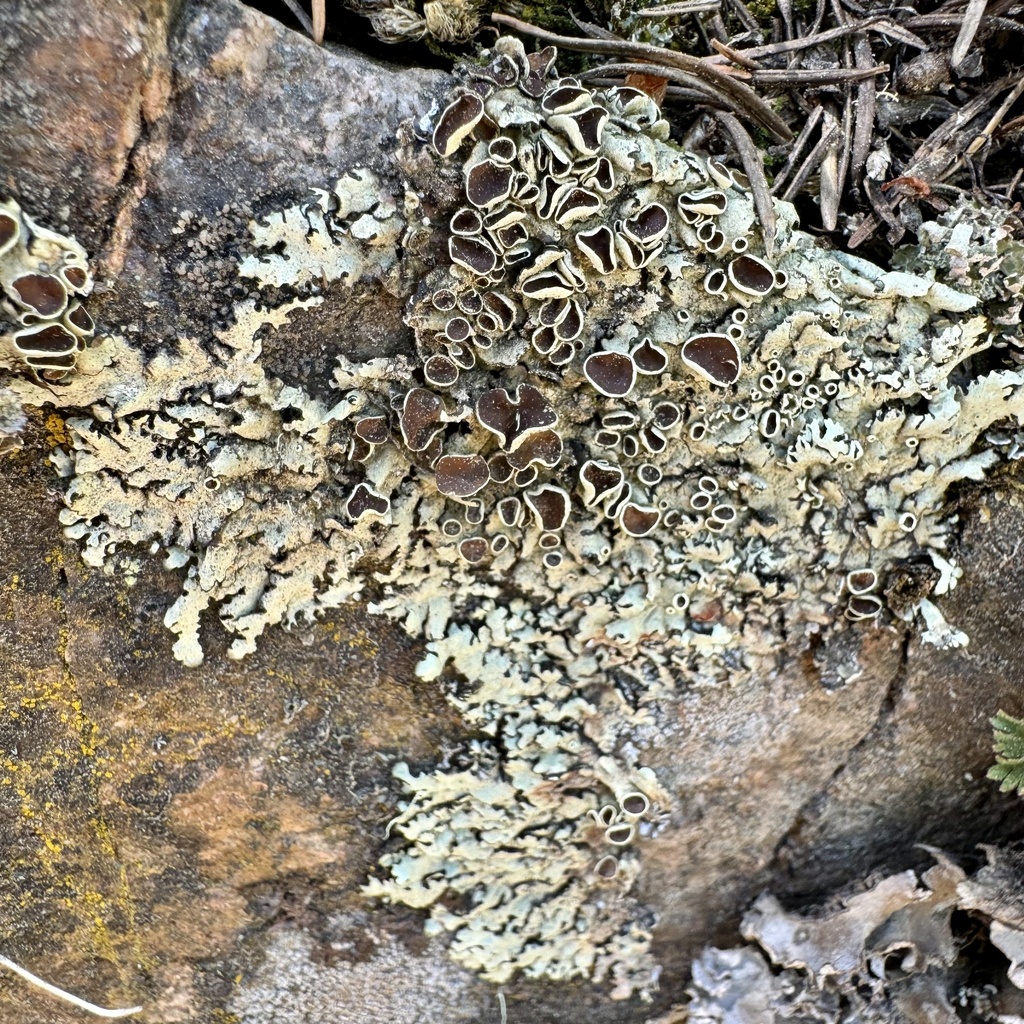
Yellow-green to olive-green rosettes tightly appressed to rock surfaces, Xanthoparmelia cumberlandia is one of the most common foliose rock lichens in eastern North America. It forms neat, circular thalli 3–15 cm in diameter on exposed boulders and outcrops.
The upper surface bears isidia (small, finger-like outgrowths) rather than soredia, and its lobes are closely attached to the rock surface. The undersurface is pale tan to dark brown with simple rhizines.
The genus Xanthoparmelia is one of the largest lichen genera in the world, with over 800 species, almost all restricted to rock substrates.
Identification
- Yellow-green to olive-green rosettes closely appressed to rock.
- Upper surface isidiate (with tiny finger-like projections), not sorediate.
- Lobes 2–5 mm wide, forming neat circular thalli.
- Underside pale tan to brown (not black); simple rhizines.
- Always on rock, never on bark. Medulla K+ yellow then red (salazinic acid).
Ecology & Habitat
Dominates exposed, sun-lit siliceous rock surfaces. One of the first foliose lichens to colonize bare rock in eastern North America. Tolerates full sun, extreme heat, and periodic drought. Often found with crustose rock lichens and Umbilicaria species.
Fun Facts
The genus Xanthoparmelia contains over 800 species worldwide, making it one of the largest lichen genera. Almost all grow on rock, never on bark.
It is one of a handful of lichens that can tolerate rock surface temperatures exceeding 60°C in summer sun, shutting down photosynthesis and surviving in a dormant state until conditions cool.
In Aboriginal Australian culture, a related species (X. semiviridis) was used as a food additive in bread-making.
It is often confused with species in the closely related genus Flavoparmelia, but the key distinction is substrate: Xanthoparmelia grows on rock, Flavoparmelia on bark.
Distribution
Eastern North America, from the Appalachians to the Great Plains