Overview
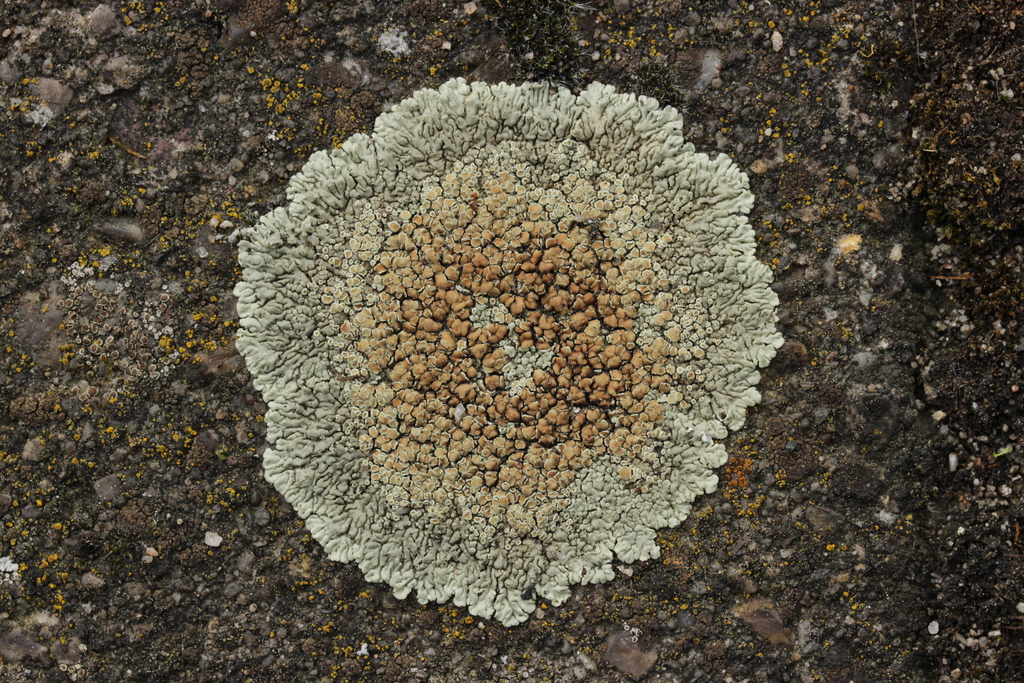
Yellow-green to greenish-gray rosettes with distinct lobes at the margins and crowded apothecia in the centre, Protoparmeliopsis muralis is one of the most common lichens on human-made stone surfaces. It forms neat circular patches 1–5 cm across on walls, pavements, and gravestones.
Despite its crustose growth form, the marginal lobes are clearly defined and give it a rosette appearance. The abundant tan to olive apothecia often dominate the centre of the thallus.
Formerly classified as Lecanora muralis, it is an extremely resilient species tolerant of heavy metals, drought, and air pollution, making it one of the most successful urban lichens worldwide.
Identification
- Forms neat circular rosettes with distinct lobes at the margin.
- Yellow-green to greenish-gray colour, sometimes with a whitish pruina.
- Abundant apothecia in the centre, tan to olive with a thin thalline margin.
- Almost always found on stone, concrete, or mortar rather than bark.
- Lobes are convex and closely appressed to the substrate.
Ecology & Habitat
One of the first colonizers of bare stone and concrete. Dominates urban surfaces where few other lichens survive. Tolerates heavy metal contamination, extreme drought, and temperature fluctuations. Often found alongside Xanthoria parietina on sunny walls.
Fun Facts
It is the lichen you are most likely to see without trying . If you have walked past a stone wall, pavement, or gravestone, you have almost certainly walked past this species.
Taxonomists moved it from Lecanora to Protoparmeliopsis based on molecular data, making it one of many lichens whose names have changed in the genomics era.
It can colonize concrete within 5 years of construction, making it one of the fastest pioneer lichens on human-made surfaces.
Studies have shown it accumulates heavy metals like lead and zinc from the atmosphere, and researchers have used it to map urban pollution patterns.
Distribution
Cosmopolitan; found across North America, Europe, Asia, and Australasia