Overview
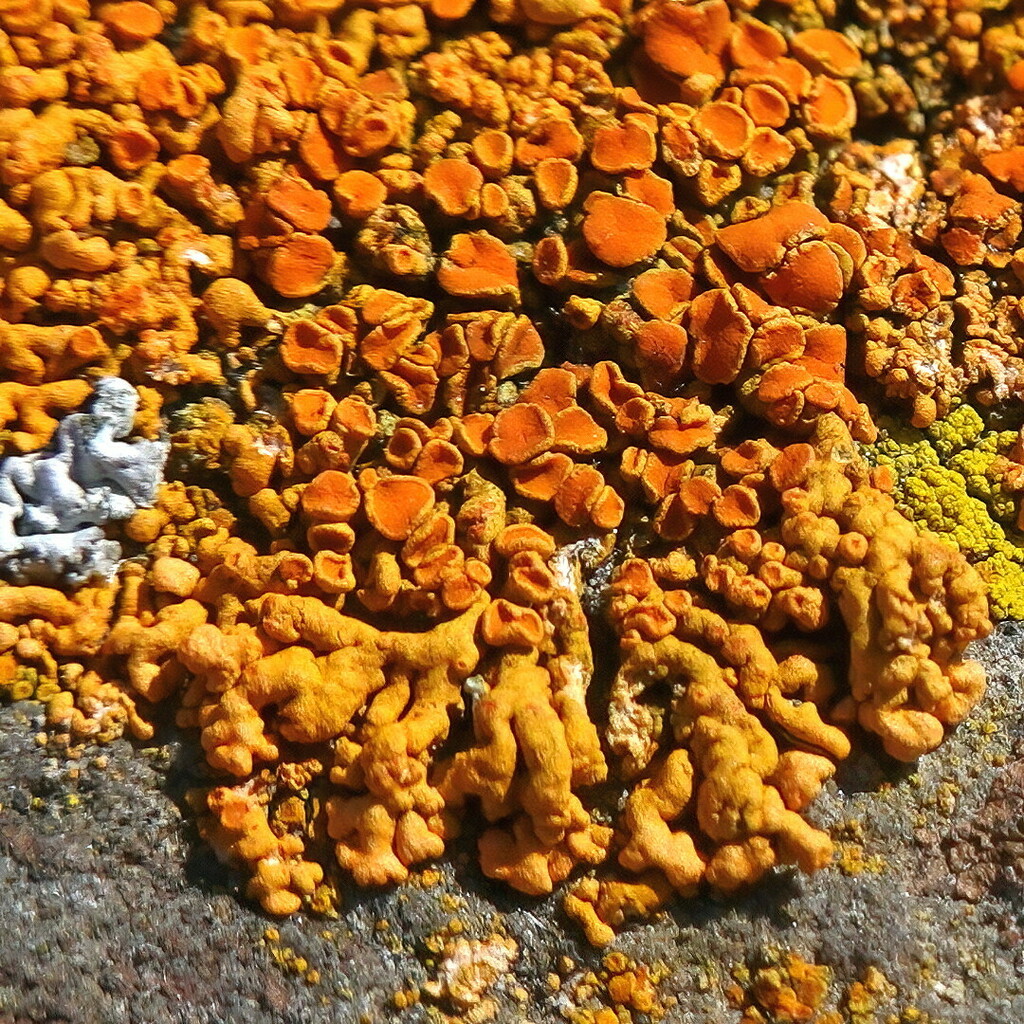
Intensely orange to red-orange, Rusavskia elegans forms brilliant rosettes on rock surfaces, particularly where birds perch. It is one of the most brightly coloured lichens in the world and a familiar sight on mountain summits and coastal cliffs.
Closely related to Xanthoria parietina but preferring rock over bark, it thrives in exposed, nutrient-enriched sites. The vivid colour comes from parietin, an anthraquinone pigment that protects the algal partner from intense UV radiation at high altitudes.
Formerly known as Xanthoria elegans, it has been used as a model organism for studying lichen growth rates and is one of the few lichens whose age can be reliably estimated from its diameter.
Identification
- Intense orange to red-orange colour; brighter and more red than Xanthoria parietina.
- Forms well-defined rosettes on rock, typically 2–8 cm across.
- Lobes are narrow (0.5–1.5 mm) and closely appressed, radiating neatly from the centre.
- Abundant apothecia with darker orange discs.
- K+ purple reaction on cortex confirms anthraquinone pigments.
Ecology & Habitat
A nitrophile of rock surfaces, particularly common below bird perches on cliffs, mountain summits, and coastal rocks. Tolerates extreme UV radiation, freezing, and desiccation. Often the most conspicuous organism on alpine rock faces.
Fun Facts
It has been used as a biological clock . Because it grows at a remarkably constant radial rate (about 0.5 mm per year in the Arctic), scientists use its diameter to date rock surfaces, a technique called lichenometry.
Like its cousin X. parietina, it survived 14 days in open space on the International Space Station during ESA's EXPOSE experiment, tolerating vacuum, cosmic radiation, and extreme temperature swings.
The vivid orange colour intensifies with altitude and sun exposure; shaded specimens can appear almost green, but the K+ purple spot test always confirms identity.
It is one of the dominant visible organisms in Antarctica, where it grows on rocks near penguin colonies that provide nitrogen from guano.
Lichenometric dating using this species has been used to date glacier retreats, rockfalls, and even ancient stone structures across the Arctic and alpine regions.
Distribution
Bipolar; common in Arctic, alpine, and coastal regions worldwide