Overview
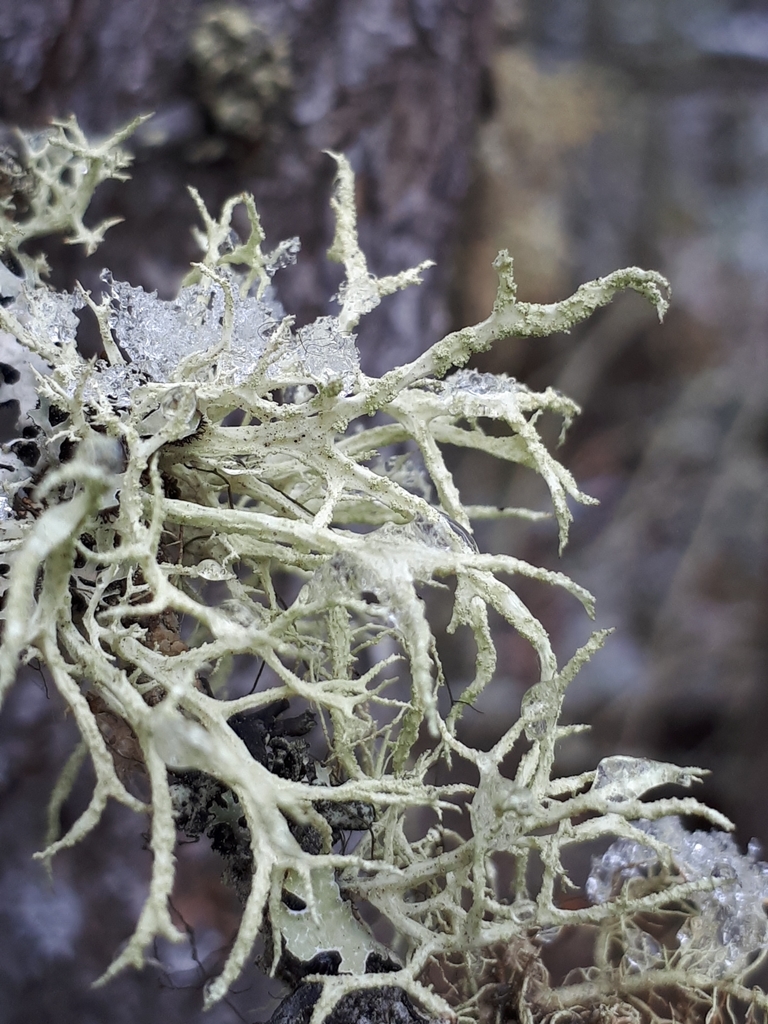
Pale yellow-green to greenish-yellow and softly branching, Evernia mesomorpha is the North American counterpart of European oakmoss (E. prunastri). It forms pendant or semi-erect tufts 3–8 cm long on branches and trunks.
The branches are flattened to angular in cross-section and covered in powdery soredia, especially on the margins and undersurface. It is one of the most common epiphytic lichens in the boreal forests of Canada and the northern United States.
Often confused with E. prunastri, it differs in its more yellow-green colour, coarser soredia, and presence of usnic acid (absent in true E. prunastri).
Identification
- Pale yellow-green to greenish-yellow tufts (3–8 cm) on bark or wood.
- Branches flattened to angular; surface sorediate, especially along margins.
- More yellow than E. prunastri, which is gray-green.
- Cortex K−, medulla K−; UV+ white (divaricatic acid).
- Common on conifers; E. prunastri prefers hardwoods.
Ecology & Habitat
One of the most abundant epiphytic lichens in the boreal forest, growing on both living and dead wood. Common on spruce, fir, birch, and poplar. Also colonizes old fences and wooden structures. More continental in distribution than E. prunastri.
Fun Facts
It is one of the top contributors to epiphytic lichen biomass in the boreal forest, where it provides insulation and nesting material for birds and small mammals.
Unlike European E. prunastri, it has not been commercially exploited for perfumery, though it contains similar fragrant compounds.
In some boreal forests, the combined biomass of Evernia, Usnea, and Bryoria can exceed the leaf biomass of the trees they grow on.
It can photosynthesise at temperatures as low as -10°C when sufficient light is available, allowing it to grow during the long, cold boreal winter whenever the sun shines.
Distribution
North America, primarily boreal and northern temperate regions; also parts of East Asia