Overview
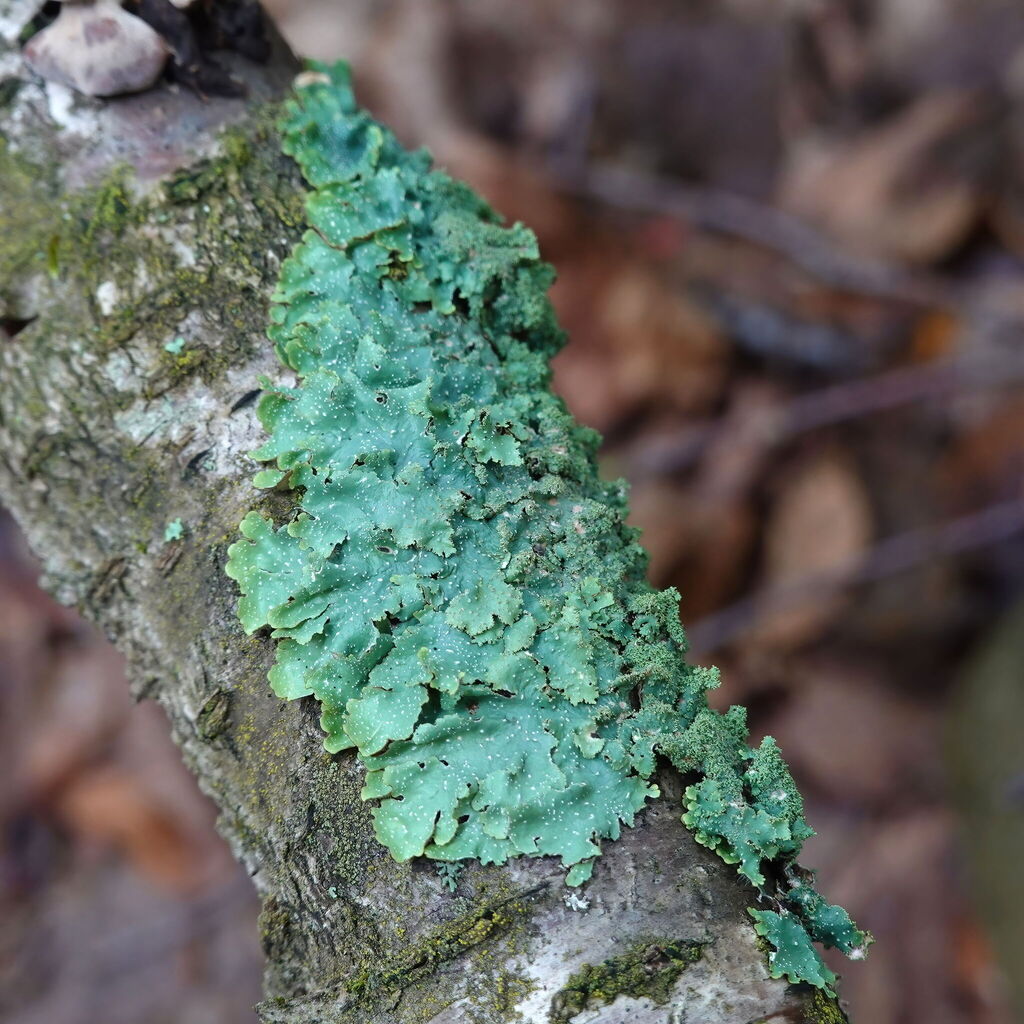
Gray to blue-gray with distinctive white spots (pseudocyphellae) scattered across its upper surface, Punctelia rudecta is one of the most common foliose lichens on trees in eastern North America. The name 'Punctelia' refers to these punctiform (dot-like) white markings.
It forms loosely attached rosettes up to 15 cm across, with broad, rounded lobes. Laminal soredia develop from the pseudocyphellae, giving older specimens a granular texture in the centre.
Similar to Parmelia sulcata in general appearance but distinguished by the scattered dot-like pseudocyphellae rather than a network pattern.
Identification
- Gray to blue-gray with scattered white dots (pseudocyphellae) on the upper surface.
- Soredia develop from the pseudocyphellae, becoming granular in the centre.
- Broad, rounded lobes (3–8 mm) forming loosely attached rosettes.
- Underside black with simple rhizines; margins often pale brown.
- Medulla C+ red (lecanoric acid); cortex K−.
Ecology & Habitat
Common on mature deciduous trees in open woodland, parks, along roadsides, and in suburban settings. Moderately pollution-tolerant and has been expanding its range as air quality improves. Often found alongside Flavoparmelia caperata and Physcia species.
Fun Facts
The scattered white dots on its surface are not damage or disease — they are pseudocyphellae, tiny pores that allow gas exchange through the otherwise waterproof upper cortex.
It is one of the most commonly submitted lichens for identification on citizen science platforms like iNaturalist, thanks to its size, abundance, and photogenic appearance.
The species was long confused with European Punctelia borreri until molecular work showed them to be distinct species — a common pattern in trans-Atlantic lichen taxonomy.
Its C+ red reaction produces one of the most vivid colour changes in field chemistry, turning bright crimson-magenta with a single drop of household bleach.
Distribution
Eastern North America, also found in East Asia and parts of Europe