Overview
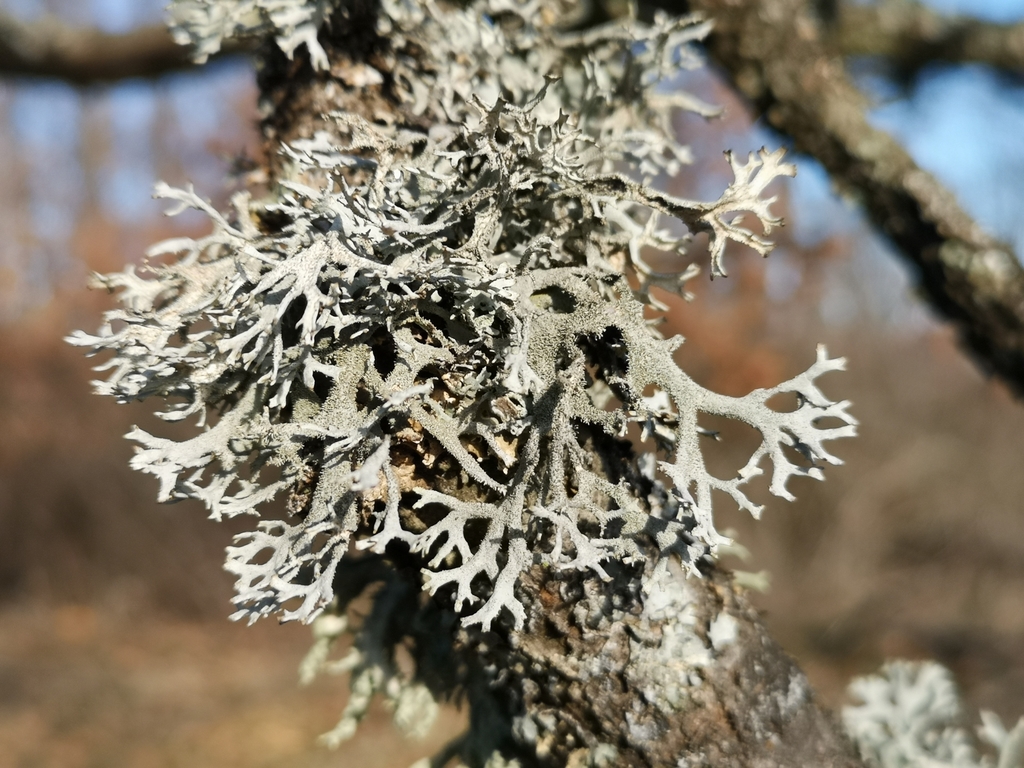
Gray to brownish-gray above and strikingly black below, Pseudevernia furfuracea forms irregular, branching tufts 3–10 cm long on conifer bark in montane forests. The contrast between the pale upper surface and jet-black underside is its most distinctive feature.
The upper surface bears fine soredia and isidia, giving it a rough, furfuraceous (scurfy) texture that inspired its species name. It is one of the most common and conspicuous epiphytic lichens in European mountain forests.
Like true oakmoss (Evernia prunastri), it has been used in perfumery, though less extensively. It contains atranorin and physodic acid, giving it a distinct chemical profile.
Identification
- Gray to brownish-gray above with a strikingly black underside.
- Irregularly branching tufts (3–10 cm) on bark; branches strap-shaped and flattened.
- Surface rough with fine soredia and isidia (furfuraceous texture).
- Cross-section shows white medulla between gray cortex above and black cortex below.
- Medulla K−, C−, P+ red (physodic acid).
Ecology & Habitat
Common on conifer bark in montane and boreal forests. Sensitive to sulphur dioxide and has declined in polluted lowland areas but remains abundant at higher elevations. One of the dominant lichen species in spruce-fir forests across the Northern Hemisphere.
Fun Facts
The black underside is unusual among lichens and makes it instantly recognizable — if a gray lichen flipped over reveals jet-black, it is very likely this species.
It has been harvested for use in perfumery alongside oakmoss, though its scent profile is more woody and less sweet. The fragrance industry calls it "tree moss absolute."
In traditional European medicine, it was used as a stuffing for pillows, believed to promote restful sleep.
Its sensitivity to SO₂ made it a key species in early air pollution mapping studies across Europe, where its retreat from industrial areas was documented over decades.
Distribution
Circumboreal; widespread in Europe, North America, and Asia at higher elevations