Overview
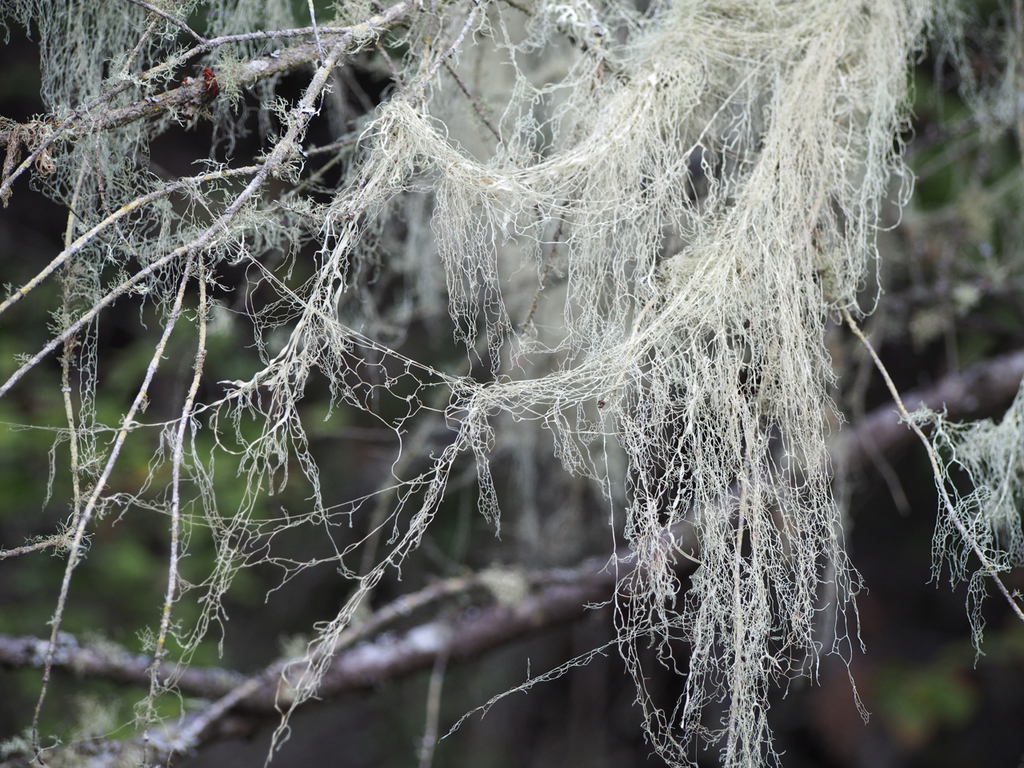
Long, lace-like, pale green strands hanging in curtains from tree branches, Ramalina menziesii is the state lichen of California and one of the most visually spectacular lichens in North America. Individual thalli can reach over 1 meter in length.
The thallus is strongly flattened (strap-shaped) with a distinctive net-like (reticulate) pattern of perforations and ridges that gives it a lace-like appearance. It is dependent on coastal fog for moisture and is a signature organism of California's oak woodlands and coastal forests.
The most abundant and conspicuous lichen in many coastal California ecosystems, it festoons trees in such quantities that branches can appear draped in pale green lace.
Identification
- Long (often 30–100 cm), pendant, pale green strands hanging from branches.
- Thallus strongly flattened and strap-shaped with a distinctive reticulate (net-like) pattern.
- Numerous perforations and fenestrations give the lace-like appearance.
- Apothecia occasionally present as pale discs on the strap margins.
- Distinguished from other Ramalina by its large size and net-like structure.
Ecology & Habitat
Entirely dependent on coastal and valley fog for moisture, thriving in the fog belt of the Pacific coast. Most abundant on coast live oaks and valley oaks in California. Provides important habitat for invertebrates and nesting material for birds, especially hummingbirds.
Fun Facts
In 2015, it became the official state lichen of California — making California the first (and currently only) US state to designate a state lichen.
It harvests water directly from fog . On foggy mornings, it can absorb several times its dry weight in water, beginning photosynthesis before the sun even appears.
Hummingbirds preferentially use it as camouflage for their nests, weaving pieces into the nest exterior. A nest decorated with R. menziesii is nearly invisible against a lichen-covered branch.
Named after Archibald Menzies, the Scottish surgeon-naturalist on the Vancouver Expedition (1791–1795) who first collected it along the Pacific coast.
Climate change models predict its range will shift northward as fog patterns change along the California coast, potentially devastating the oak woodland ecosystems that depend on it for moisture capture.
Distribution
Pacific coast of North America, from British Columbia to Baja California