Overview
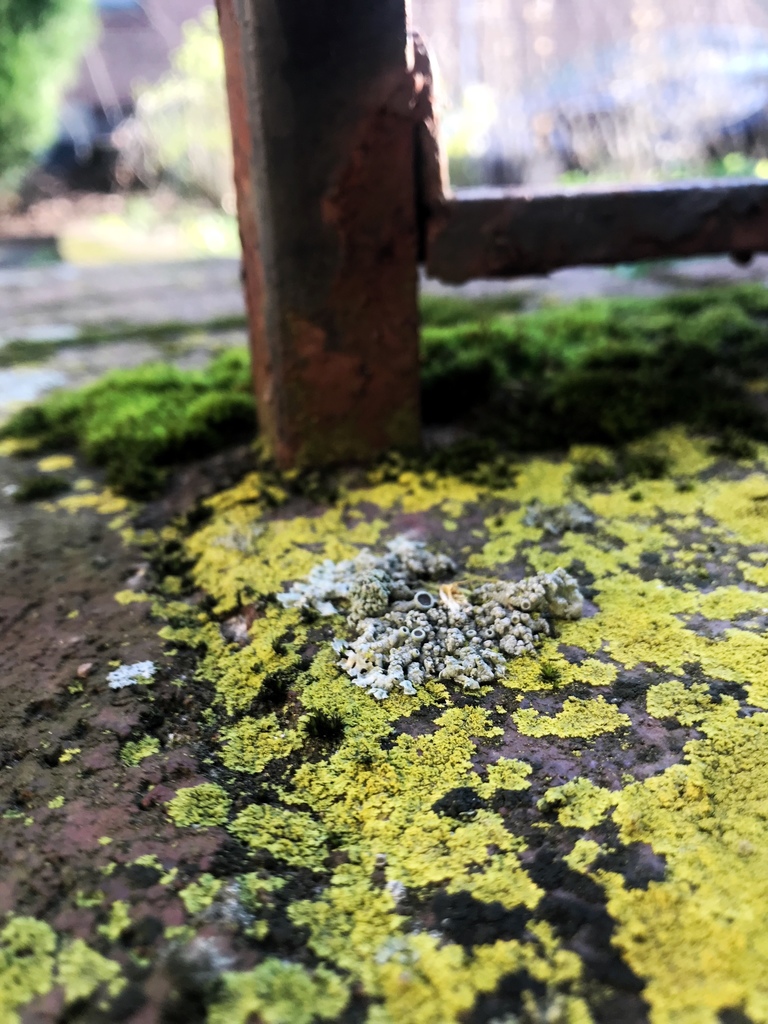
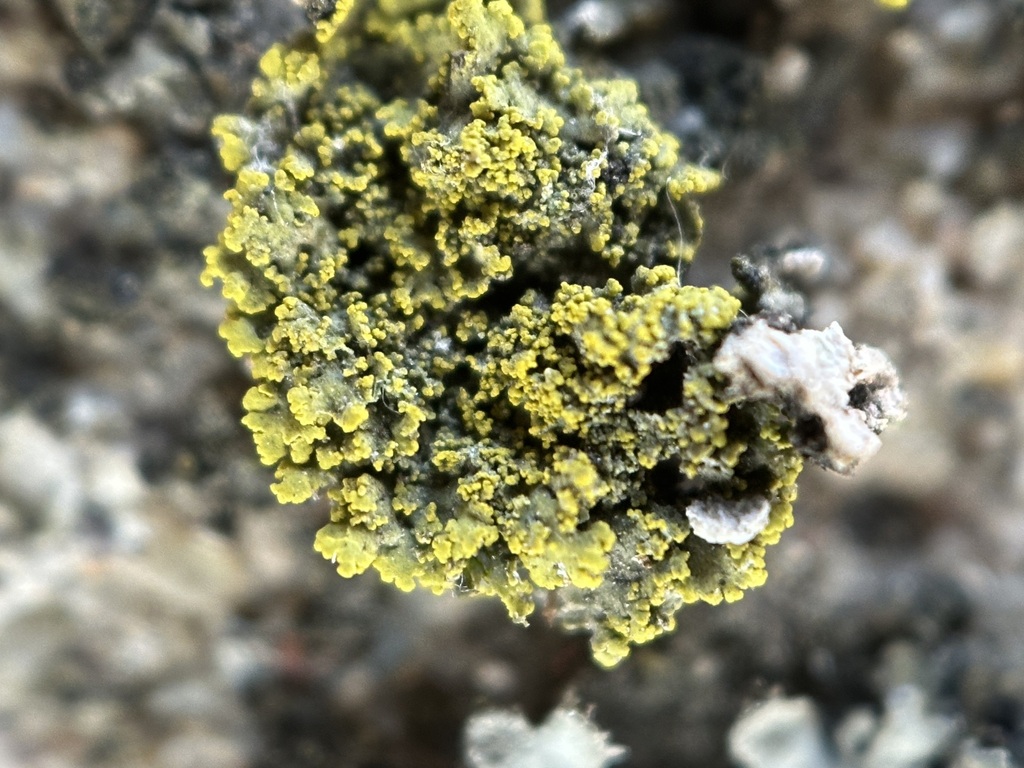
Tiny lemon- to egg-yolk-yellow rosettes, rarely more than 1 cm across, often merging into scattered yellow patches along the rain tracks and branch forks of roadside trees. Candelaria concolor is one of the commonest small yellow lichens on town trees in North America and is spreading in Britain.
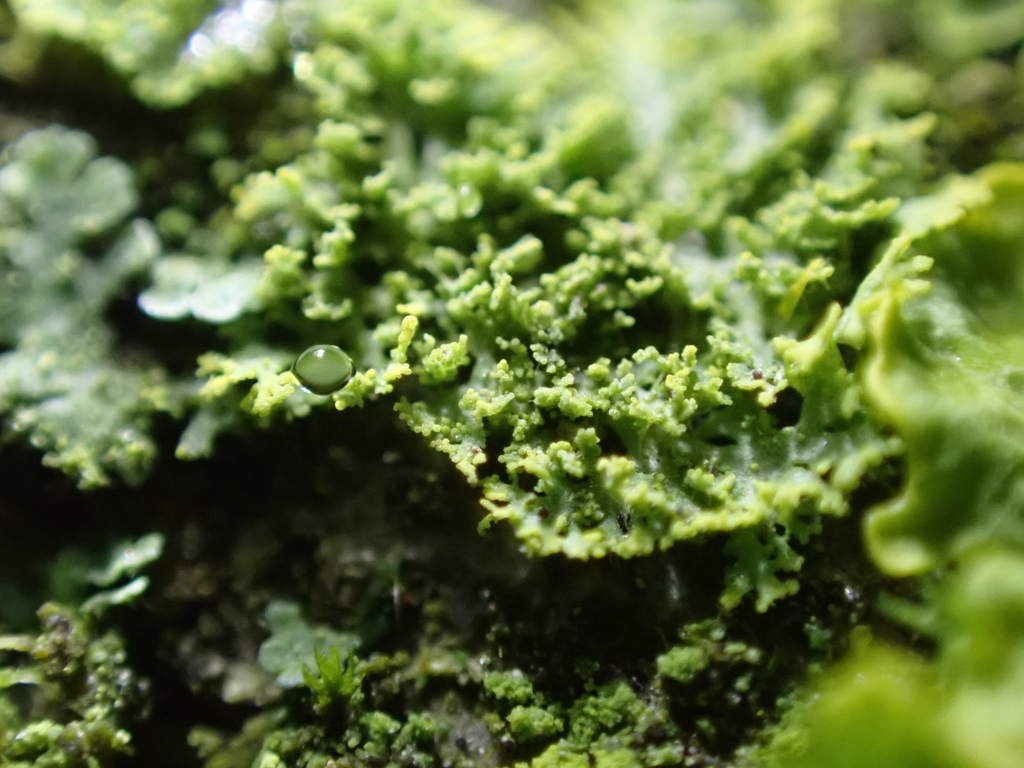
Its lobes are minute (about 1 mm long and 0.2–0.5 mm wide), finely divided and scalloped. The lobe margins break down into yellow granules and coarse soredia, so older colonies can look like a yellow crust. The underside is whitish, with scattered white rhizines.
The colour comes from pulvinic-acid pigments such as calycin, the hallmark of its family, the Candelariaceae. Unlike the orange Xanthoria species it often grows beside, it does not react with K.
Identification
- Bright lemon-yellow to yellow-green rosettes under 1 cm across; lobes only 0.2–0.5 mm wide.
- Lobe tips and margins granular or sorediate; whole patches can dissolve into yellow granules.
- Underside white, with scattered white unbranched rhizines (lift a lobe with a pin to check).
- Apothecia rare; when present 0.4–1 mm, dull yellowish-brown.
- All spot tests negative (K−, C−, KC−, P−). K− separates it from orange-yellow Xanthoria and Xanthomendoza, which turn K+ purple.
Ecology & Habitat
Grows on the nutrient-rich, well-lit bark of roadside and parkland broadleaved trees, especially in branch forks and along water tracks where nutrients collect. The British Lichen Society links its recent spread to its tolerance of nitrogen. In North America it favours soft, rough-barked trees such as ash, walnut, elm and maple and tends to avoid oak (Missouri Department of Conservation). It is a typical member of nitrogen-loving bark communities with Physcia, Phaeophyscia and Xanthomendoza.
Fun Facts
A whole rosette is often about the size of a fingernail, so it is usually noticed as yellow speckling on bark rather than as individual lichens.
Its spread in Britain is attributed to rising nitrogen deposition, which makes it a useful marker of nutrient-enriched air.
Its relatives the goldspecks (Candelariella) share the same yellow pigments but are crusts with no lower surface or free lobes.
A colony of candleflame lichen with few other lichen species around it can indicate polluted, nitrogen-rich air (Missouri Department of Conservation).
Distribution
Widespread and common in North America and Europe; recorded worldwide. Throughout Britain and Ireland, commonest in the south and spreading