Overview
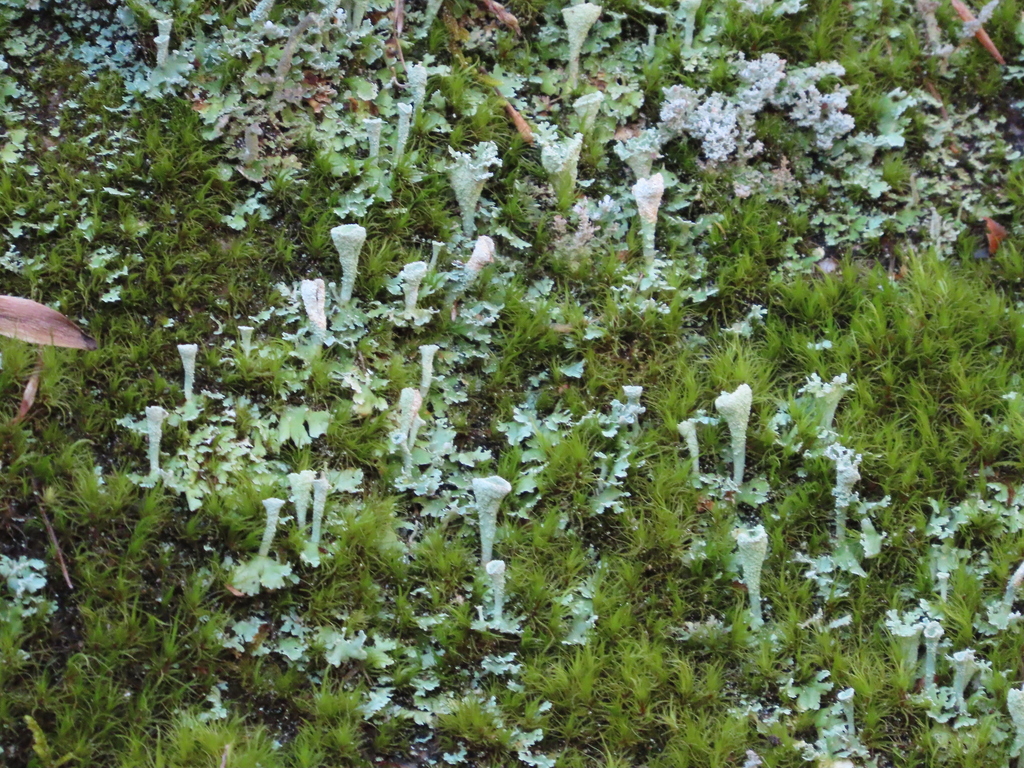
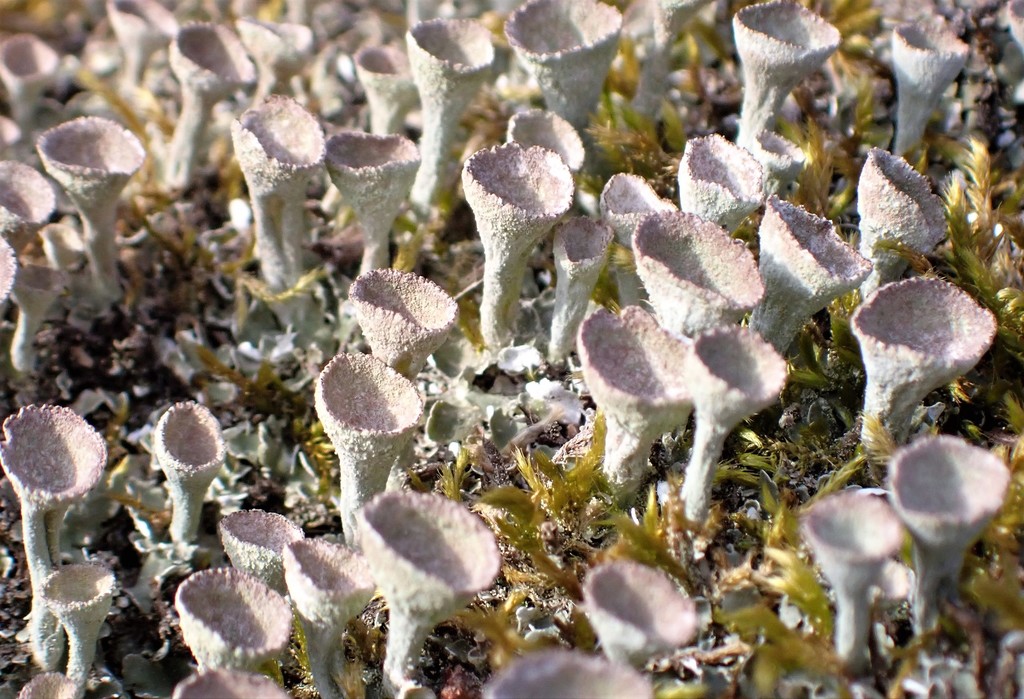
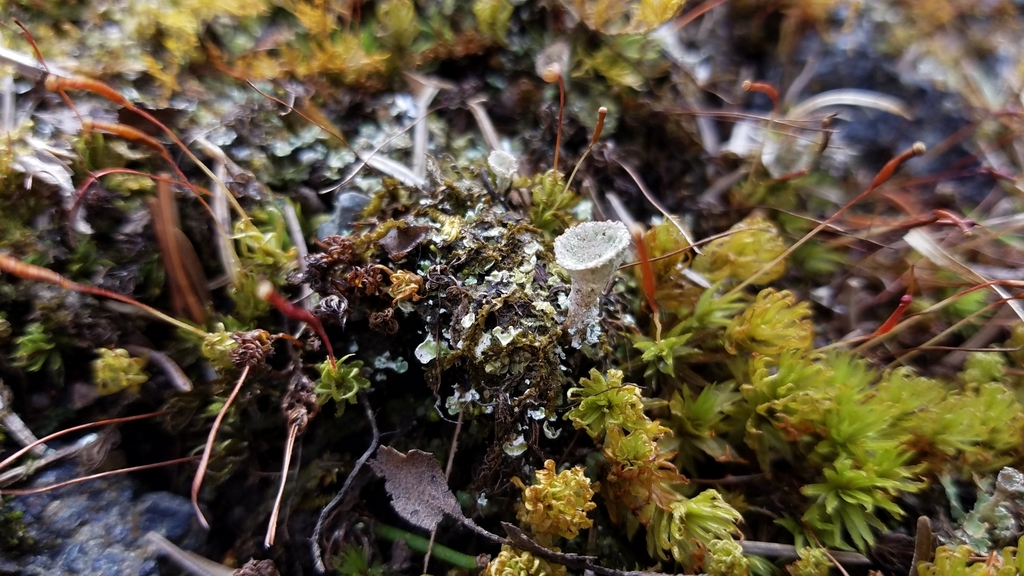
Grey-green goblets 0.5–2.5 cm tall rising from a bed of small leafy squamules, Cladonia chlorophaea is one of the classic pixie-cup lichens. The cups are usually 3–6 mm across and taper gradually into the stalk. Their inner and upper surfaces are covered in granular, mealy soredia, which make the cups look dusty under a hand lens.
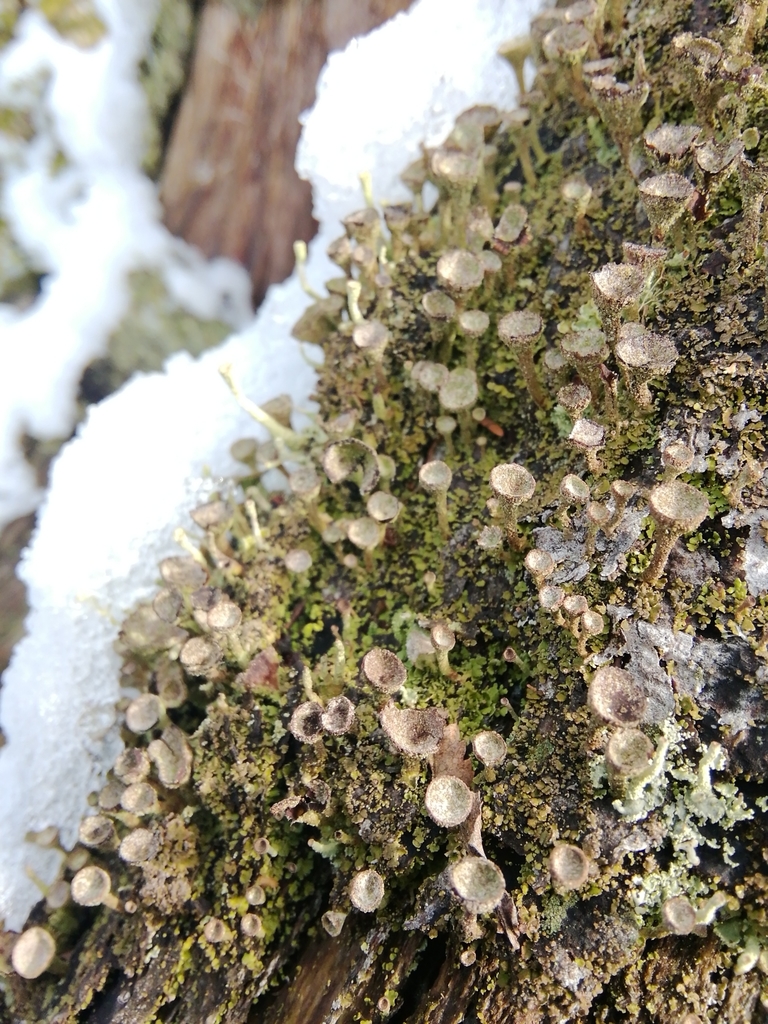
Brown pycnidia (tiny dots) are common on the cup rims, and brown apothecia sometimes form there too. New cups often sprout from the margins of old ones.
It is really a complex of near-identical species that differ in chemistry. All produce fumarprotocetraric acid (P+ red); separating members such as C. grayi needs thin-layer chromatography.
Identification
- Goblet-shaped cups 3–6 mm wide on stalks 0.5–2.5 cm tall, rising from basal squamules.
- Inside and upper outside of the cups mealy to granular with soredia; lower stalk patchily corticate.
- Stalk does not blacken at the base.
- P+ red (fumarprotocetraric acid); K−, C−, KC−, UV−.
- C. pyxidata has coarse, pebble-like corticate granules and no powder; C. fimbriata has narrower trumpet cups abruptly joined to a long stalk and is covered in fine, flour-like soredia.
Ecology & Habitat
Grows on less acidic substrates than its close relative C. grayi: rotting logs and stumps, tree bases, old worked timber, soil banks and acid grassland. On very acid peat and heathland it tends to be replaced by C. grayi. Like other Cladonia, it begins as a mat of basal squamules and produces its cups later.
Fun Facts
It was long treated as a variety of Cladonia pyxidata before being recognised as a species in its own right.
Its species complex is a textbook example of "chemical species": lichens that look identical but produce different secondary compounds.
The tiny brown dots on the cup rims are pycnidia, which release microscopic asexual spores (conidia).
Distribution
Every continent except Antarctica; common across much of the US and Canada and widespread in Britain and Ireland