Overview
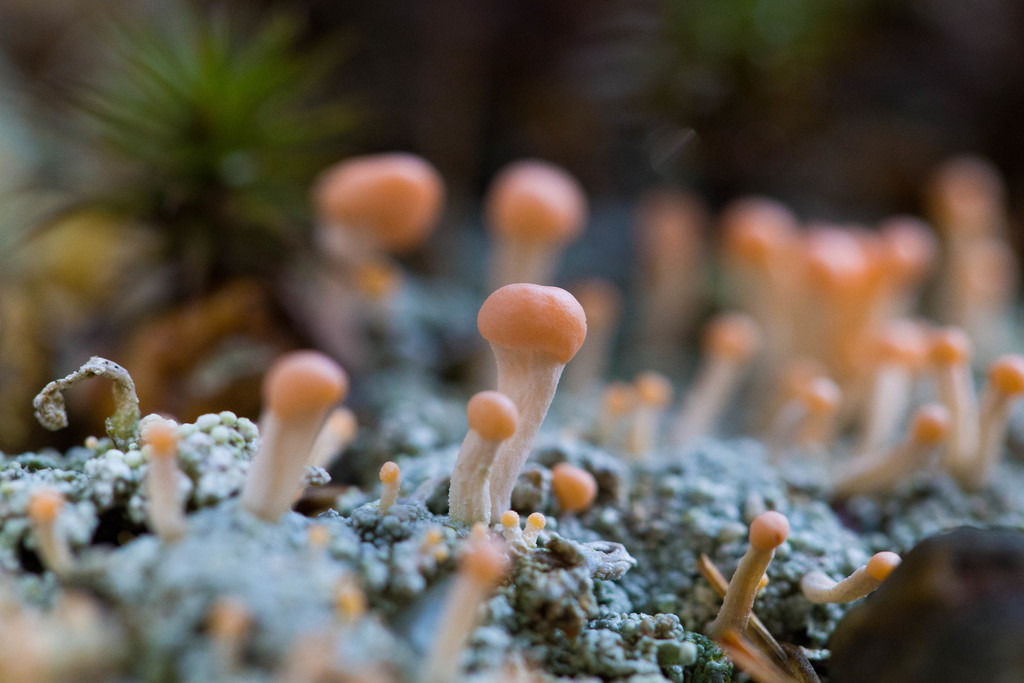
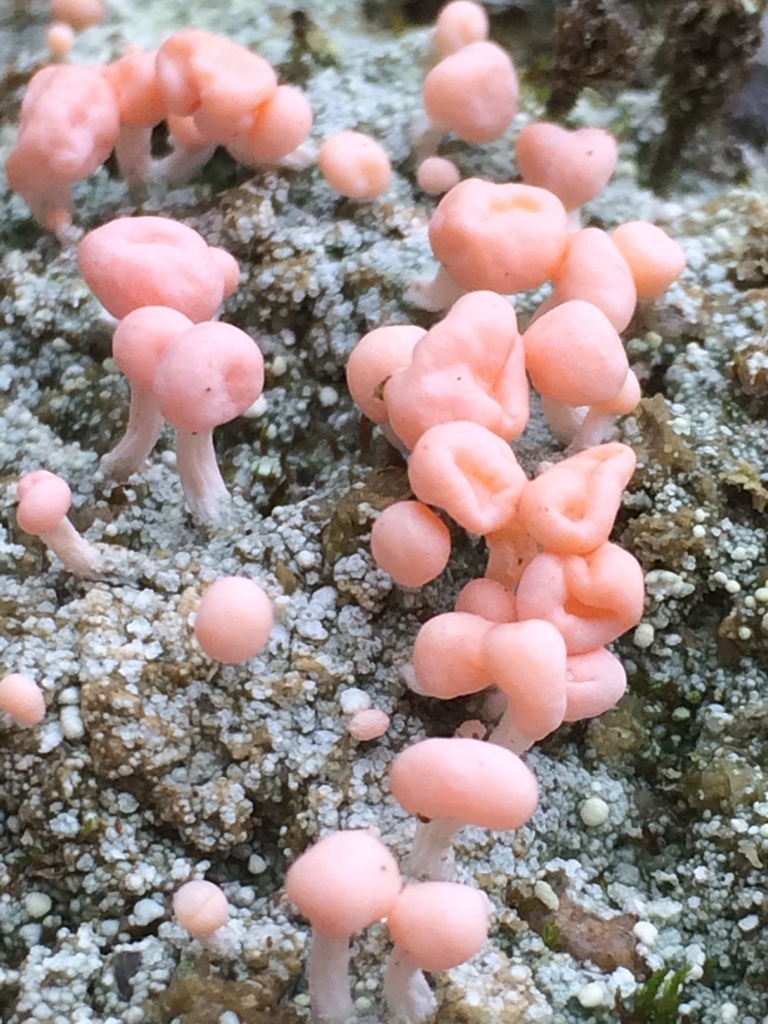
Bubblegum-pink balls on short white stalks, rising from a pale grey crust on bare soil: Dibaeis baeomyces looks more like a cluster of tiny mushrooms than a lichen. The pink heads are its apothecia, 1–4 mm across, round and almost without a rim, on stalks 2–6 mm tall.
The thallus itself is a thin, whitish to greenish-grey crust, warty or granular, sometimes breaking into small flakes. It is easily overlooked until the pink fruiting bodies appear.
It colonises freshly exposed acidic soil such as road cuts, banks and eroded tracks, and spreads quickly there for a lichen.
Identification
- Round pink apothecia (1–4 mm) on short whitish stalks (2–6 mm), on bare soil.
- Thallus a pale grey to whitish warty crust around the stalks.
- Thallus K+ yellow (turning orange in some accounts), P+ yellow to orange, UV+ orange.
- Baeomyces rufus has flattened, dull pink-brown to red-brown caps and is UV−.
- Icmadophila ericetorum has flat, unstalked pink discs on a mint-green crust over rotting wood or peat; Cladonia cristatella has red, not pink, tips.
Ecology & Habitat
A pioneer on unstable, sunny, acidic soils: loose sand, dry clay, roadside cuttings and disturbed heath tracks, and frost boils in the Arctic. It is most often seen where fresh ground has been exposed, before mosses and plants close over it.
Fun Facts
DNA studies showed it is not closely related to Baeomyces, the genus it was long placed in, despite their very similar stalked fruiting bodies.
Its closest relatives include the strange whiteworm lichen, Thamnolia vermicularis.
In North America, where it grows alongside candy lichen, both are sometimes nicknamed "fairy puke" for their pink-and-green colouring.
Distribution
Circumpolar temperate; common in eastern North America from the Gulf states to Newfoundland, rarer west to Alaska; scattered in Britain, Ireland and Europe