Overview
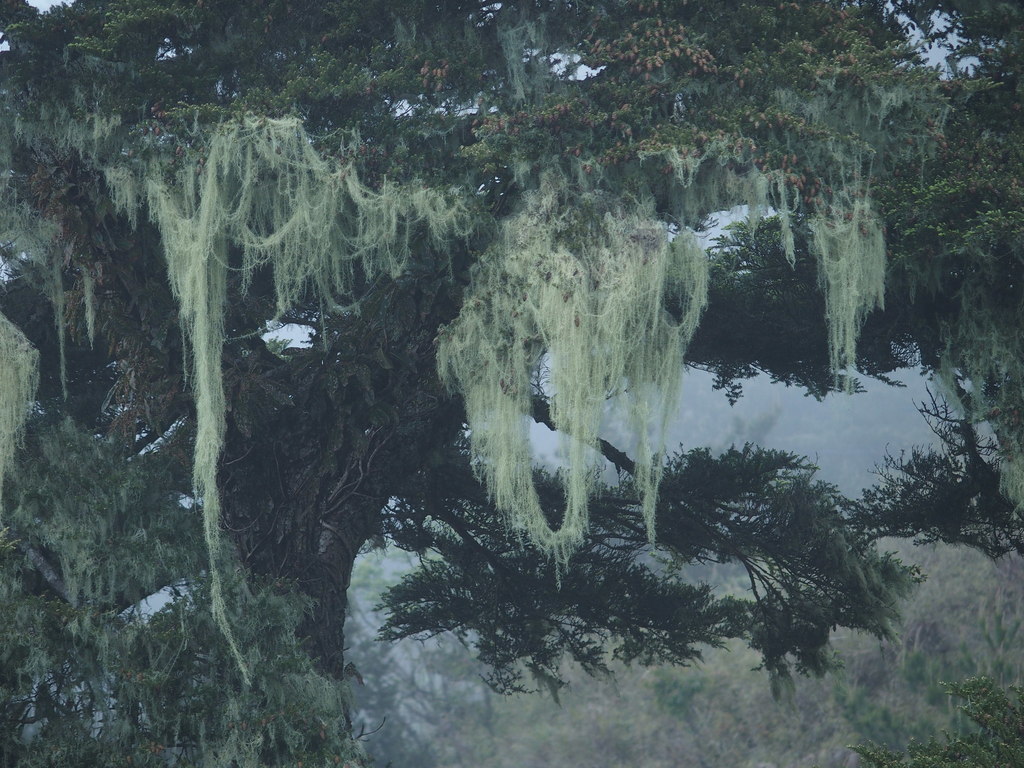
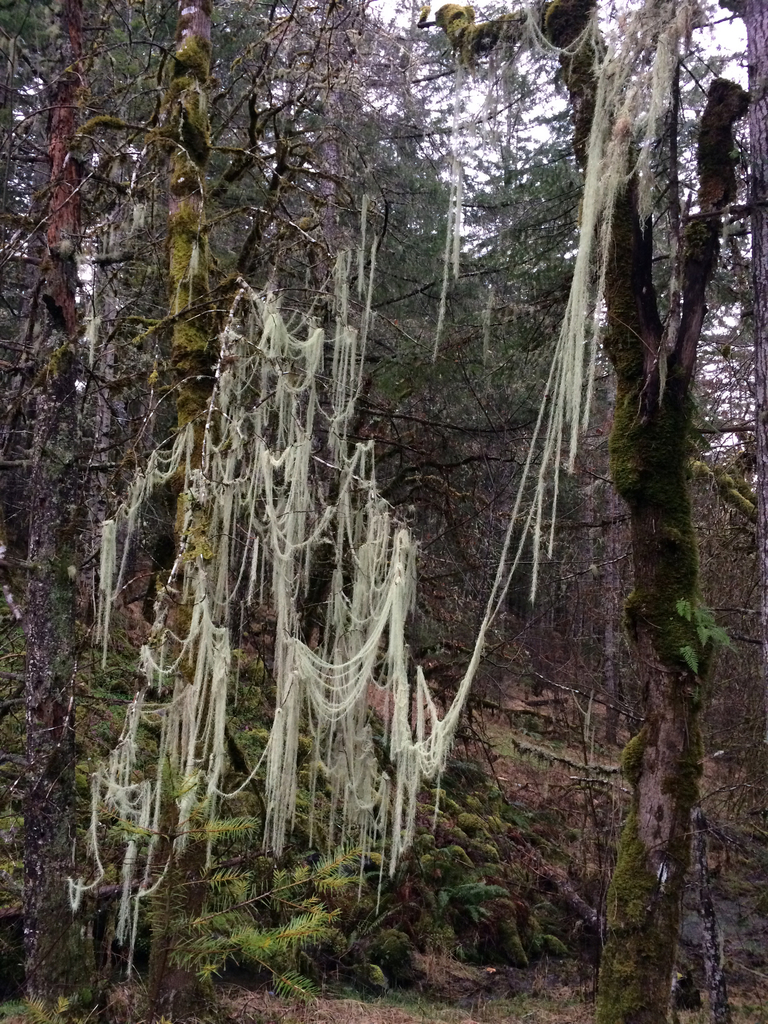
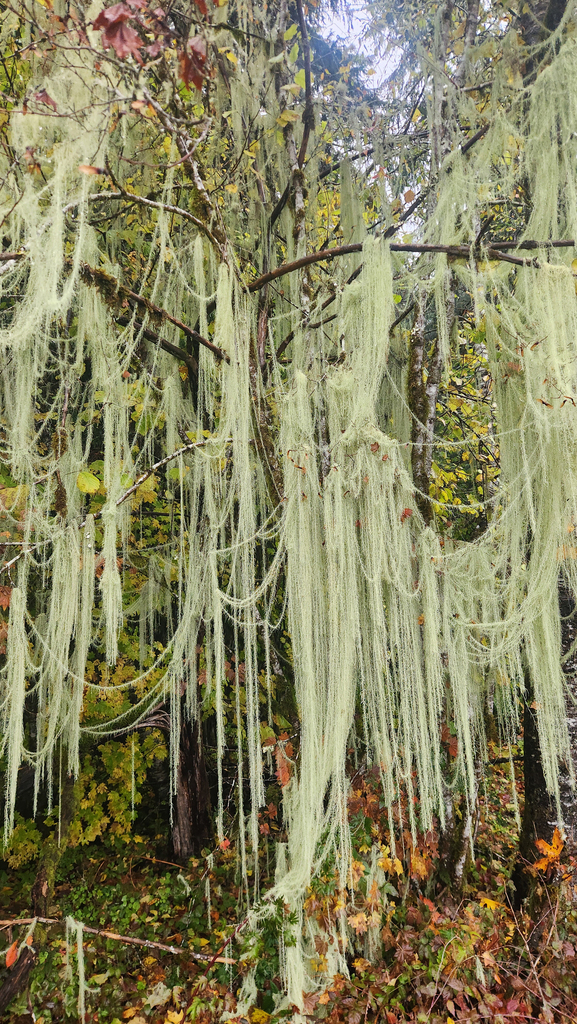
Pale yellow-green strands hanging up to several metres from forest branches, Dolichousnea longissima (long known as Usnea longissima) is often called the world's longest lichen. Each strand is a single long, rarely divided main branch clothed in dense, short side branches of even length, rather like a pipe cleaner.
Like Usnea, it has a white elastic central cord inside a hard cortex. On old main stems the cortex breaks away, leaving rough whitish patches. It reproduces almost entirely by fragments, which rarely travel more than a few metres.
That poor dispersal, together with its sensitivity to air pollution and need for humid old forest, has made it rare in many places where it was once common.
Identification
- Very long (usually 15–30 cm, reaching several metres), pale yellow-green to silvery strands draped over branches.
- Main axis long and rarely forked, densely set with short, equal side branches.
- White central cord inside: pull a strand gently and the cord stretches.
- Cortex peels from older stems, leaving white patches; apothecia extremely rare.
- Alectoria sarmentosa is similar in colour and habit but has no central cord; Ramalina menziesii forms flat, net-like straps.
Ecology & Habitat
Grows in humid, often fog-influenced forests, typically old-growth or long-undisturbed stands, on slopes and ridges and near lakes and rivers. Because it spreads mostly by fragments falling only a few metres, it recolonises slowly once lost. In Skuleskogen National Park, Sweden, it declined by 42% between 1984 and 2021 (Esseen et al. 2023), with nitrogen deposition and changing winters among the suspected causes.
Fun Facts
The USDA Forest Service gives lengths of up to 20 feet (about 6 m).
People have used it for bedding, for medicine and to strain pitch used to seal canoes, and animals use it for forage and nest material (USDA Forest Service).
It is red-listed as Endangered in Norway and protected in Sweden; the two countries hold Europe's largest populations.
It was moved from Usnea to its own genus, Dolichousnea ("long Usnea"), in 2004.
Distribution
Circumboreal: Pacific coast from northern California to southern Alaska; Upper Midwest and Great Lakes east to the Atlantic; Scandinavia and Europe; Asia; also parts of Africa