Overview
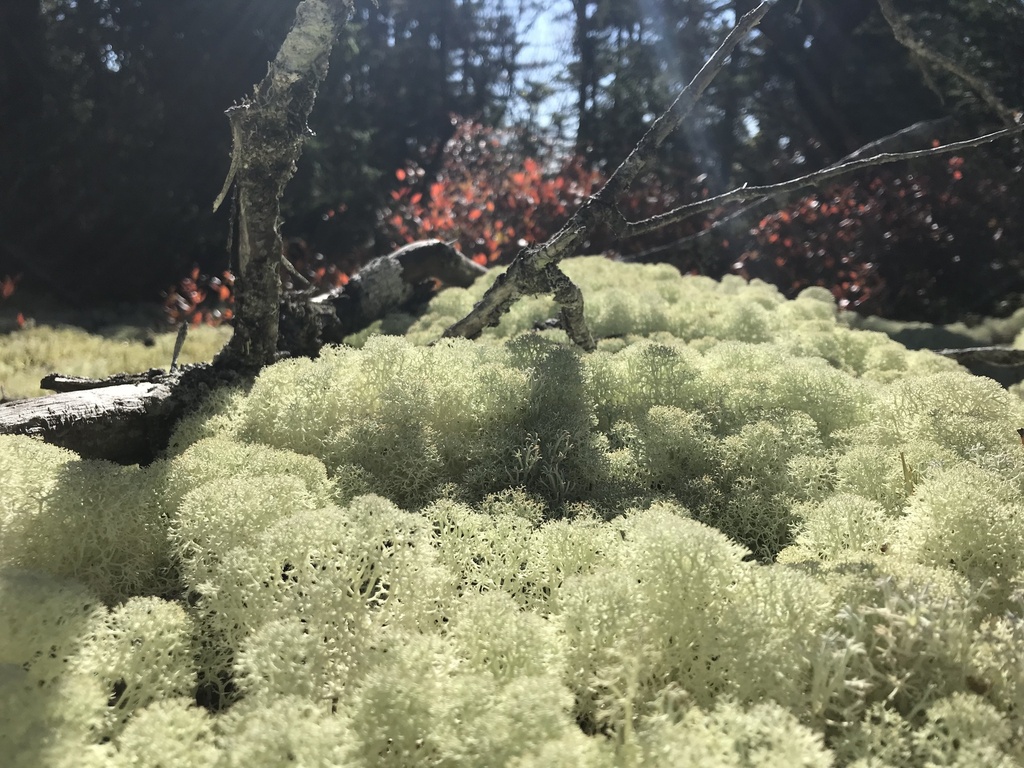
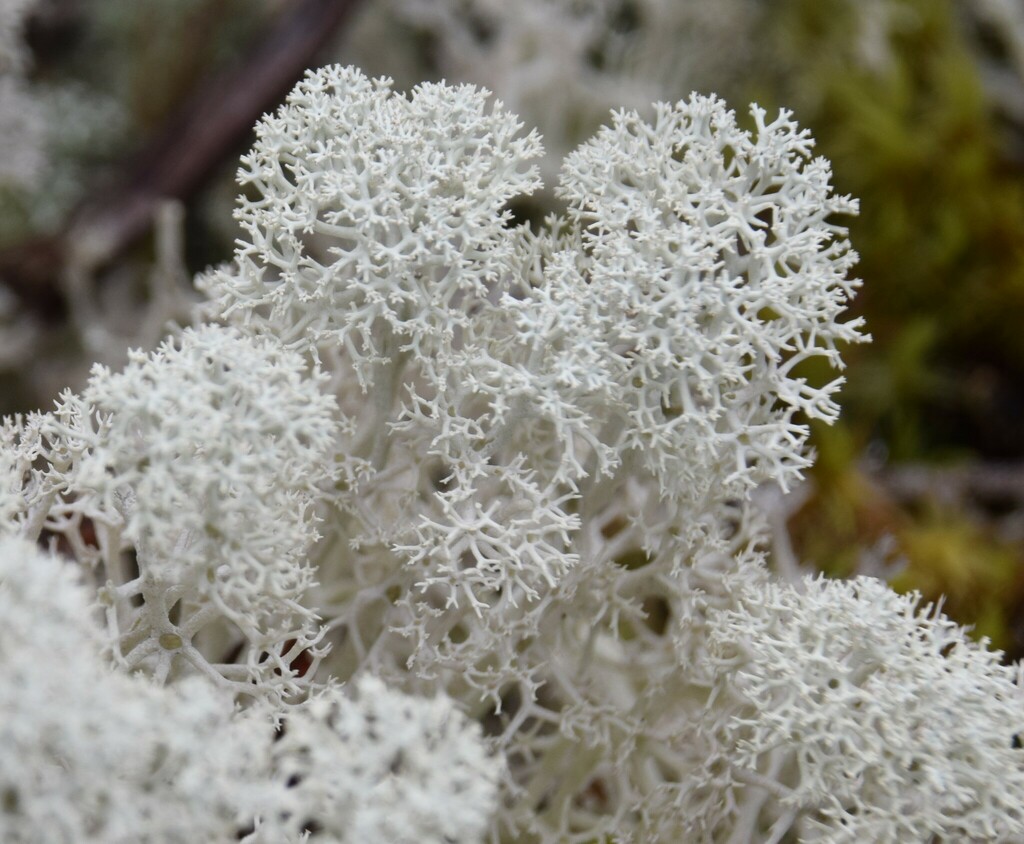
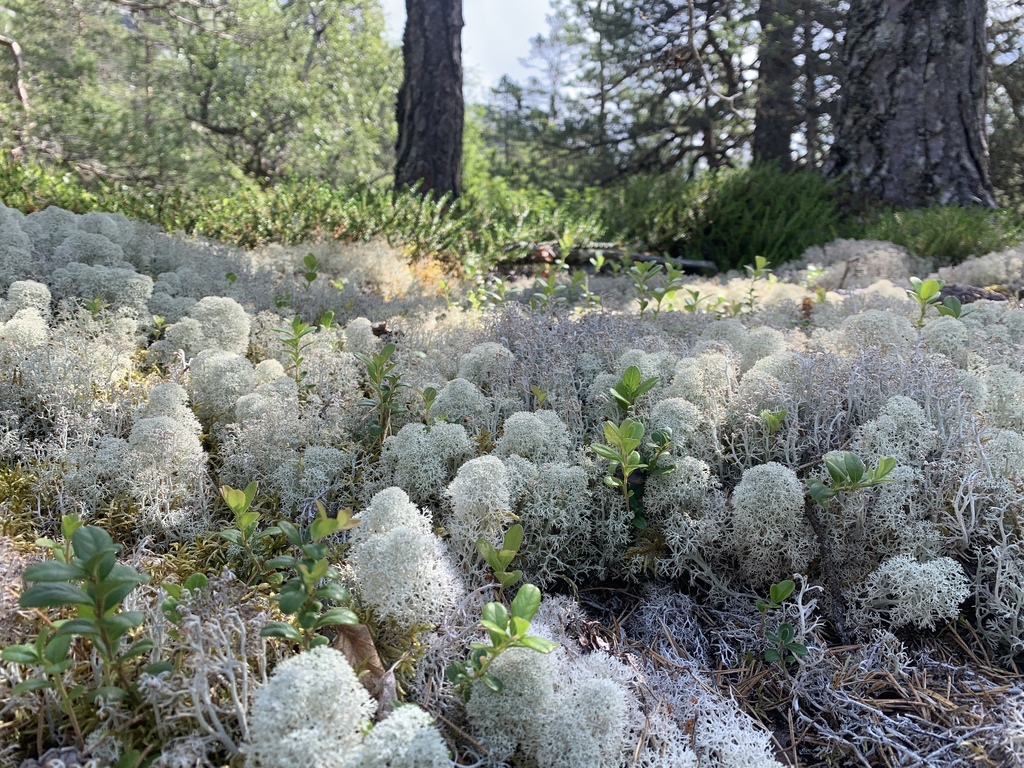
Pale yellowish-green to whitish cushions that look like heads of cauliflower or tiny clouds, Cladonia stellaris can carpet the ground of northern lichen woodlands almost completely. Each cushion is a dense, rounded mass of finely branched hollow stalks (podetia) with no obvious main stem.
Look closely at the tips: the final branches typically divide into four or five short points arranged like a star, which gives the species its common name. The branching is so dense that whole mats form a continuous, springy surface.
It grows slowly (around 4–5 mm a year in Alaska and northern Russia), so grazed, trampled or burned mats take years to decades to recover.
Identification
- Pale yellowish-green, rounded cauliflower-like heads; no distinct central stem.
- Branch tips divide in fours and fives, star-like.
- K−, P−, KC+ yellow (usnic acid); sometimes UV+ blue-white (perlatolic acid). Crumble a branch to test fresh material.
- Cladonia rangiferina is grey (not yellowish), has a central stem with branch tips swept to one side, and is K+ yellow, P+ red.
- C. arbuscula and C. mitis are yellowish too, but have tree-like branching with a main axis and do not form tight rounded heads.
Ecology & Habitat
Prefers the driest, most open sites on infertile sand or bedrock, whereas C. rangiferina favours cooler, shadier ground. In mature northern Canadian lichen woodlands the ground cover can be almost pure C. stellaris. It is killed by fire and is a late colonizer afterwards: in Saskatchewan it may take 90–120 years to regain its former abundance. It does not withstand heavy grazing and trampling (USDA Fire Effects Information System).
Fun Facts
It is a key winter food for caribou and reindeer, which dig through snow to reach the mats.
In Sweden, mats clipped back to 2–3 cm took 6–8 years to become worth grazing again.
Dried and dyed, it has been sold as miniature "trees" for model railway layouts and as decorative and sound-absorbing panels.
It was chosen as Canada's unofficial national lichen in an online vote run by the Canadian Museum of Nature.
Distribution
Circumpolar boreal and Arctic; widespread in Canada and Alaska, south locally to the northern Great Lakes states and New Jersey; Scandinavia and northern Europe; doubtfully British