Overview
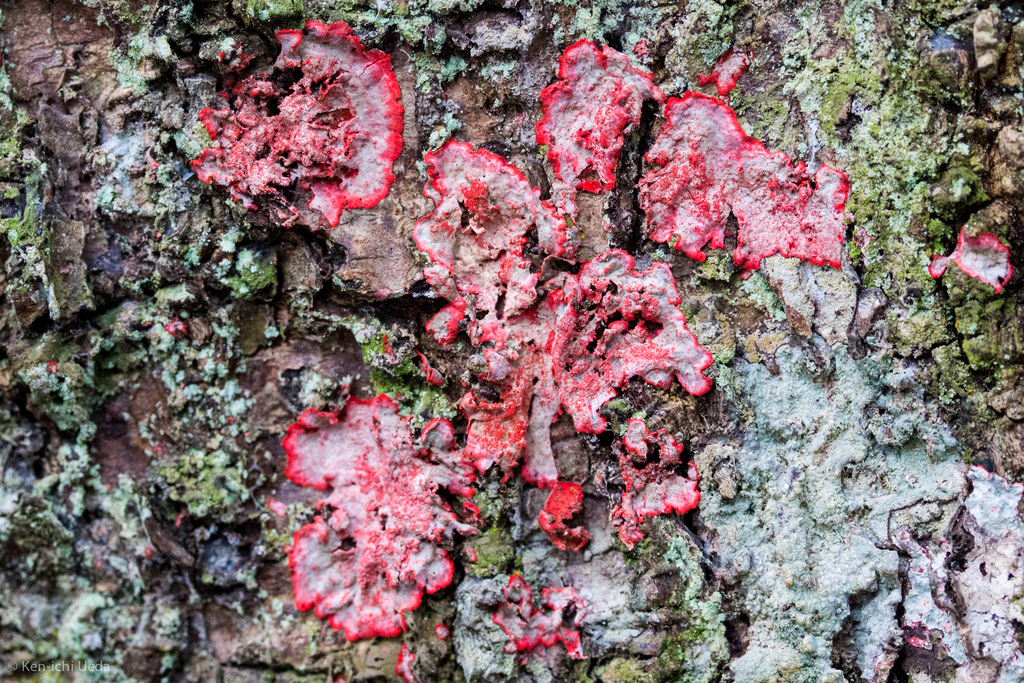
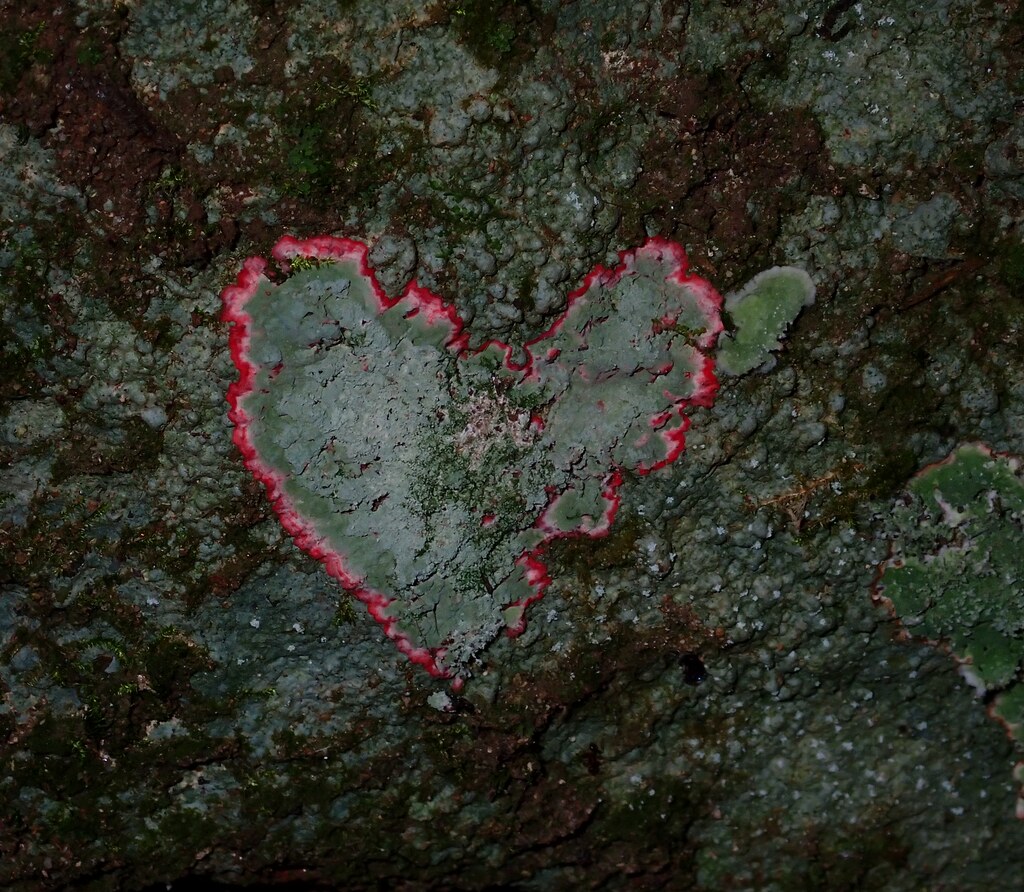
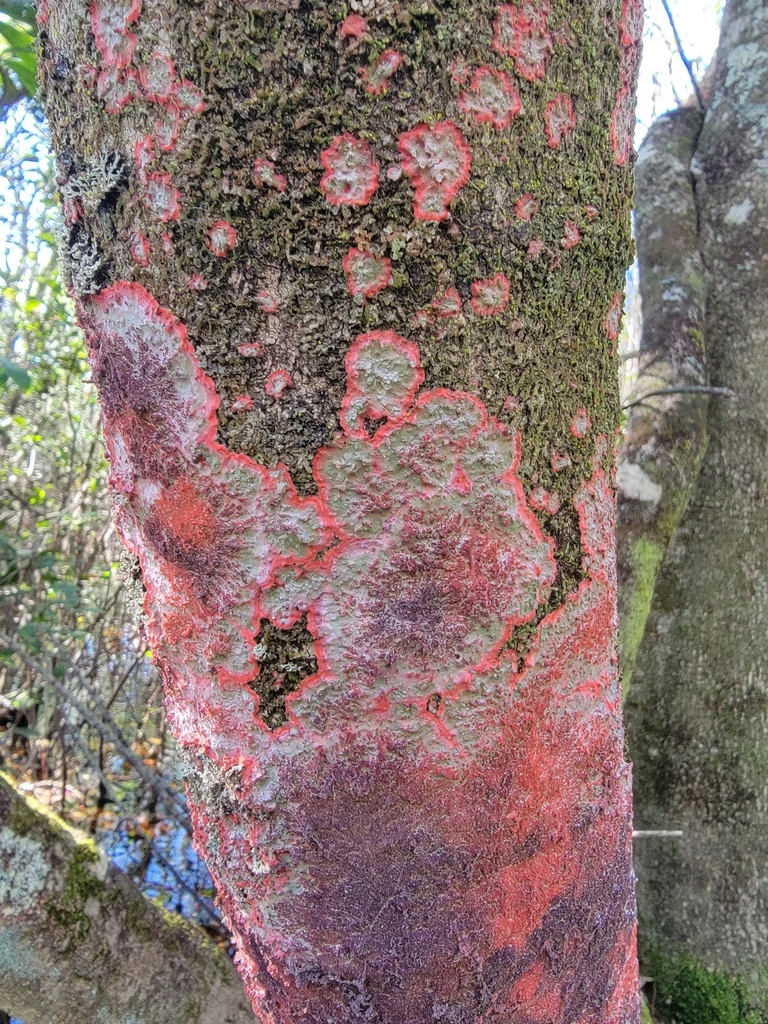
A grey-green patch with a white band and a bright scarlet, cottony rim, Herpothallon rubrocinctum (still widely known as Cryptothecia rubrocincta) looks like a Christmas wreath painted onto bark. No other lichen in its range has this red-and-green colouring. It is a familiar sight on palm, cypress and oak trunks in Florida and along the Gulf Coast.
The thallus is a thin, felt-like crust with no true cortex. The red rim is the prothallus, coloured by chiodectonic acid; the white zone owes its colour to calcium oxalate crystals; and the older centre carries red granular isidia that break off to spread the lichen.
Its photobiont is the green alga Trentepohlia. No sexual fruiting bodies are known.
Identification
- Crust on bark with three zones: grey-green centre, white band, bright red cottony margin.
- Red granules (isidia) scattered in the older centre.
- Patches can reach several decimetres across.
- Red parts K+ purple; spot tests are rarely needed because the colouring is unique.
- Within the southeastern US, nothing else combines a red rim with a grey-green centre.
Ecology & Habitat
Grows on rough bark in humid subtropical woodland, from shaded swamp forest and hammocks to sunnier sandy sites with palmettos and pines. In the United States it is restricted to the coastal plain of the Southeast, reaching its northern limit in North Carolina.
Fun Facts
Its red pigment has been used as a dye in South America (UF/IFAS Extension).
The red areas also contain beta-carotene, and the pigments are thought to help shield the lichen from strong sunlight.
In 1937 its fungus was proposed to be a basidiomycete; later chemistry and anatomy showed it is an ascomycete, like most lichen fungi.
First described by Ehrenberg in 1820, it has carried at least half a dozen names, including Chiodecton sanguineum.
Distribution
Southeastern US coastal plain from Florida and the Gulf Coast north to North Carolina; West Indies, Central and South America; rare in Africa