Overview
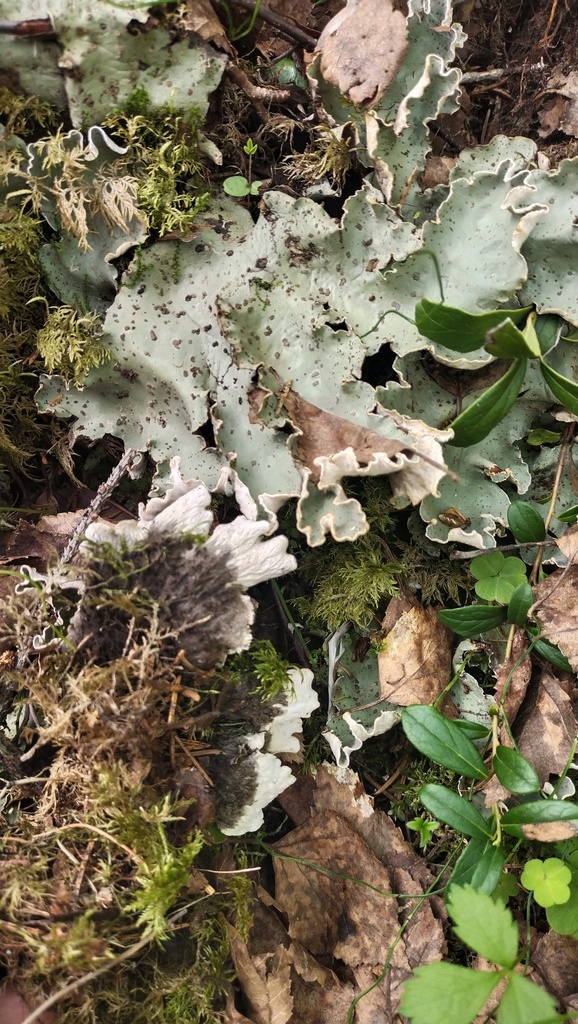
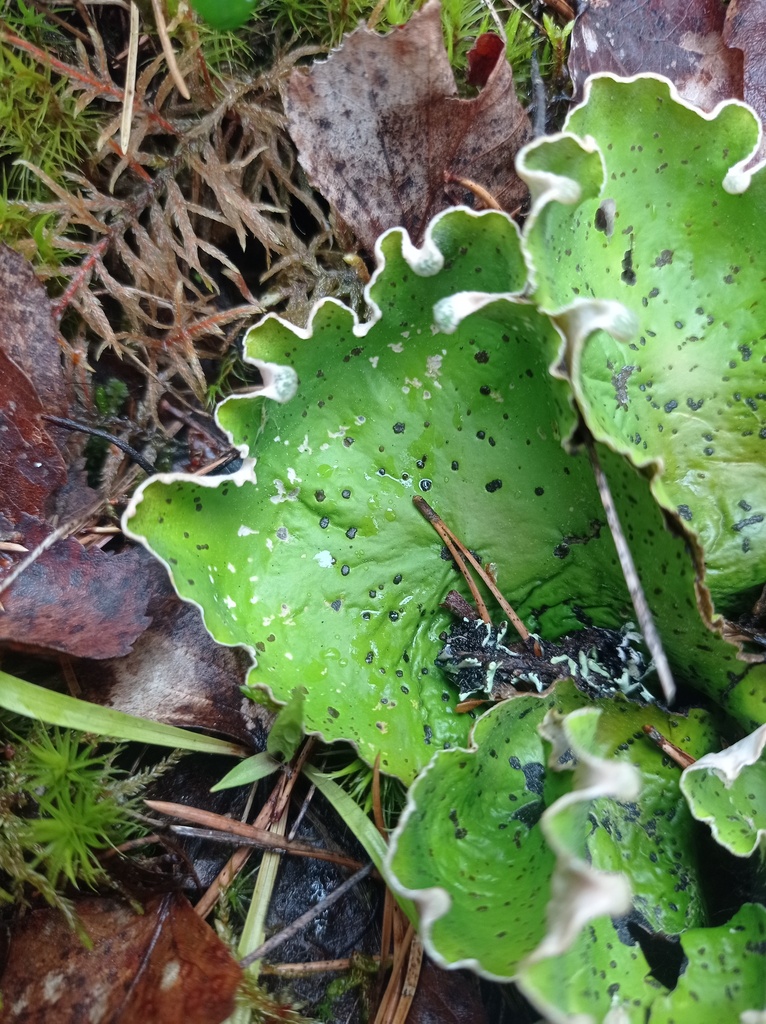
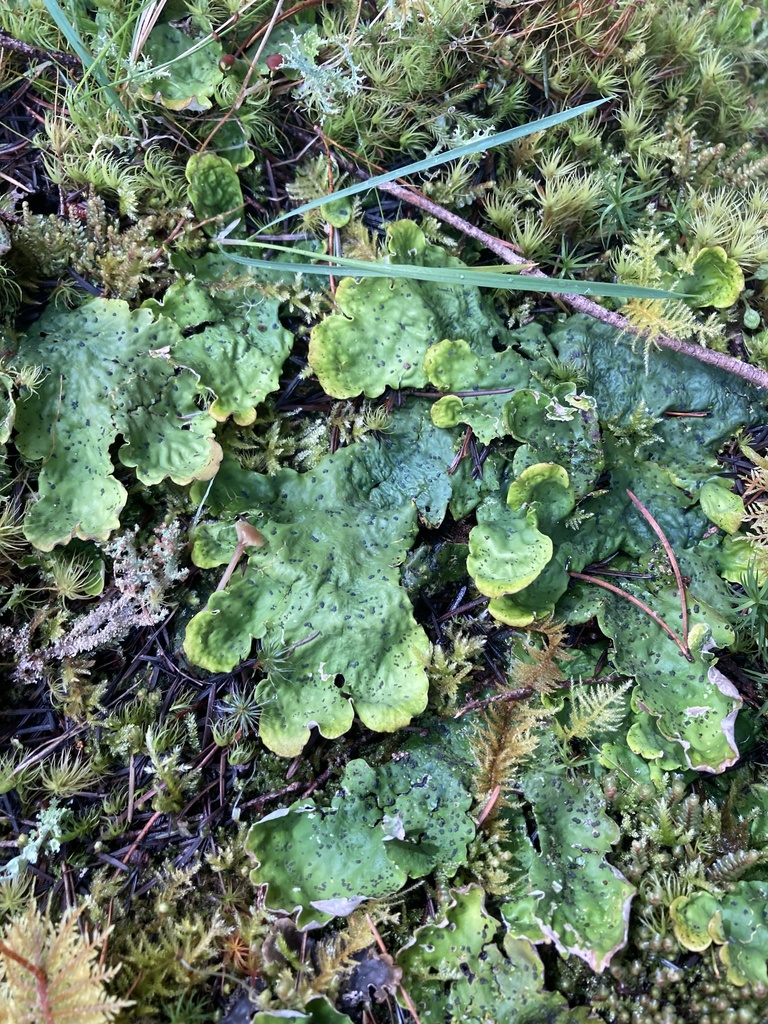
Bright, almost apple-green when wet and pale smoky grey-green when dry, Peltigera aphthosa forms broad leafy lobes over moss and soil on forest floors. Its upper surface is dotted with small dark "freckles": cephalodia, pockets of nitrogen-fixing Nostoc cyanobacteria.
Its main photosynthetic partner is a green alga (Coccomyxa), which is why it is vivid green rather than the grey or brown of most other Peltigera. The cephalodia add nitrogen fixation, so one lichen draws both carbon and nitrogen from the air.
Lobes can reach about 10 cm long and patches can spread over a metre. Large red-brown apothecia form on the lobe margins.
Identification
- Large green foliose lobes on moss or soil; vivid green when wet, grey-green when dry.
- Upper surface scattered with small, dark, warty cephalodia that are firmly attached.
- Underside without a cortex, pale at the edges and darkening toward the centre, with indistinct veins.
- Look-alike P. leucophlebia has a clear network of flattened veins below and no cortex under its apothecia; P. britannica has saucer-shaped cephalodia that detach easily, leaving white scars.
- Other common Peltigera (e.g. P. membranacea) are grey to brown and lack the freckles.
Ecology & Habitat
A ground lichen of coniferous forest, lichen woodland, bogs and tundra, more shade-tolerant than most lichens. Its cephalodia fix considerable nitrogen, a useful input on poor forest soils. It is killed by fire and slow to return: after one fire in Alaska it took about 30 years to become dominant again (USDA Fire Effects Information System). Sulphur dioxide, fluorides and acid deposition inhibit its nitrogen fixation. The British Lichen Society treats true P. aphthosa as absent from Britain; old British records belong to P. britannica or P. leucophlebia.
Fun Facts
It has two photosynthetic partners in one body: a green alga making sugars across the whole thallus, and cyanobacteria fixing nitrogen in the freckle-like cephalodia.
After the 1980 eruption of Mount St. Helens it took up aluminium and silicon from the ash, and it absorbs radioactive fallout more readily than vascular plants.
Caribou generally find it unpalatable, unlike the reindeer lichens that grow in the same woodlands.
The name aphthosa means "with aphthae" (small mouth sores), a reference to its spotted surface.
Distribution
Circumpolar in Arctic, boreal and temperate regions; across Canada and Alaska, south to the Pacific Northwest, Southwest, Great Lakes, New England and Appalachians (mostly alpine at its southern edge). Continental Europe; not in Britain