Overview
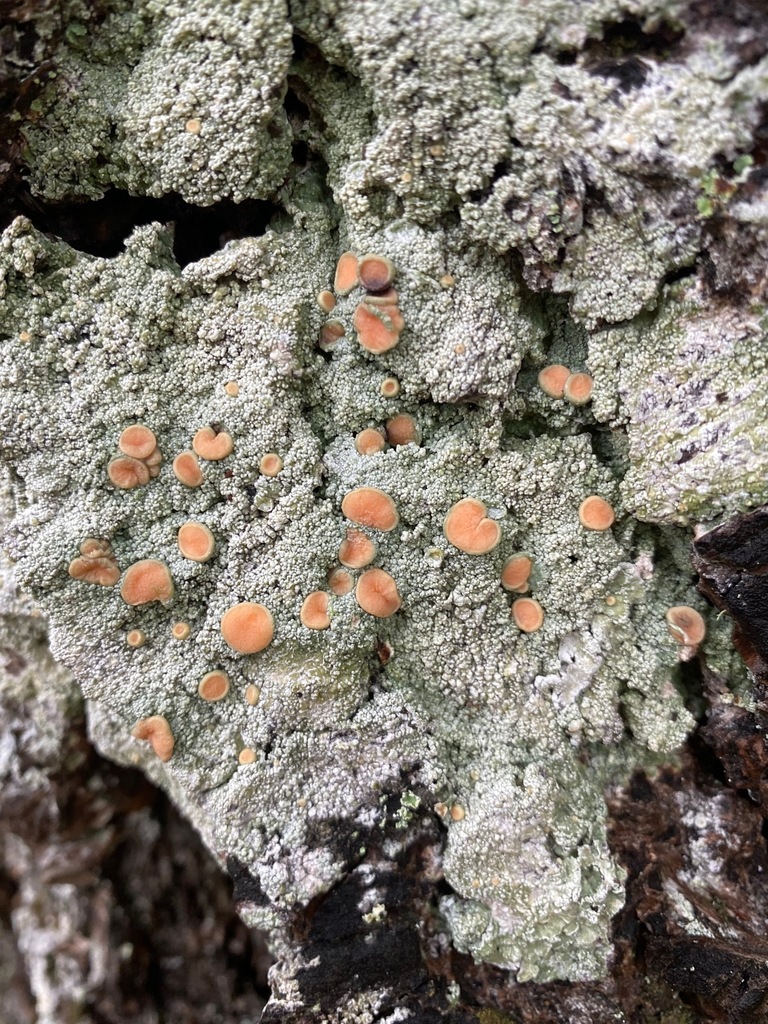
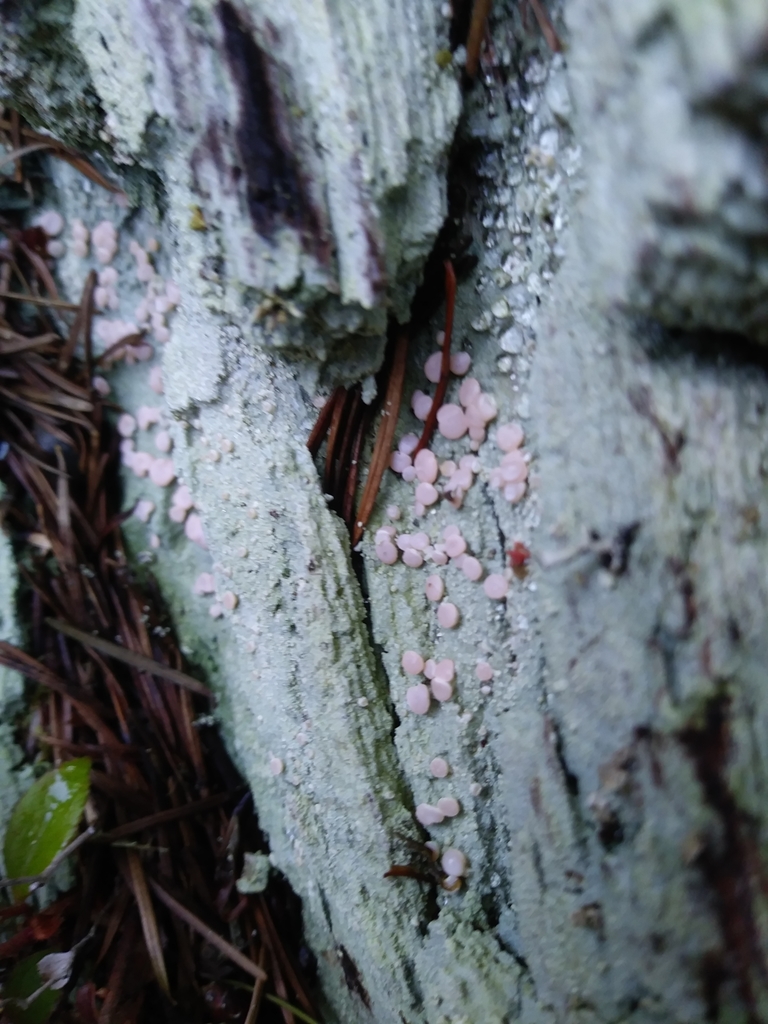
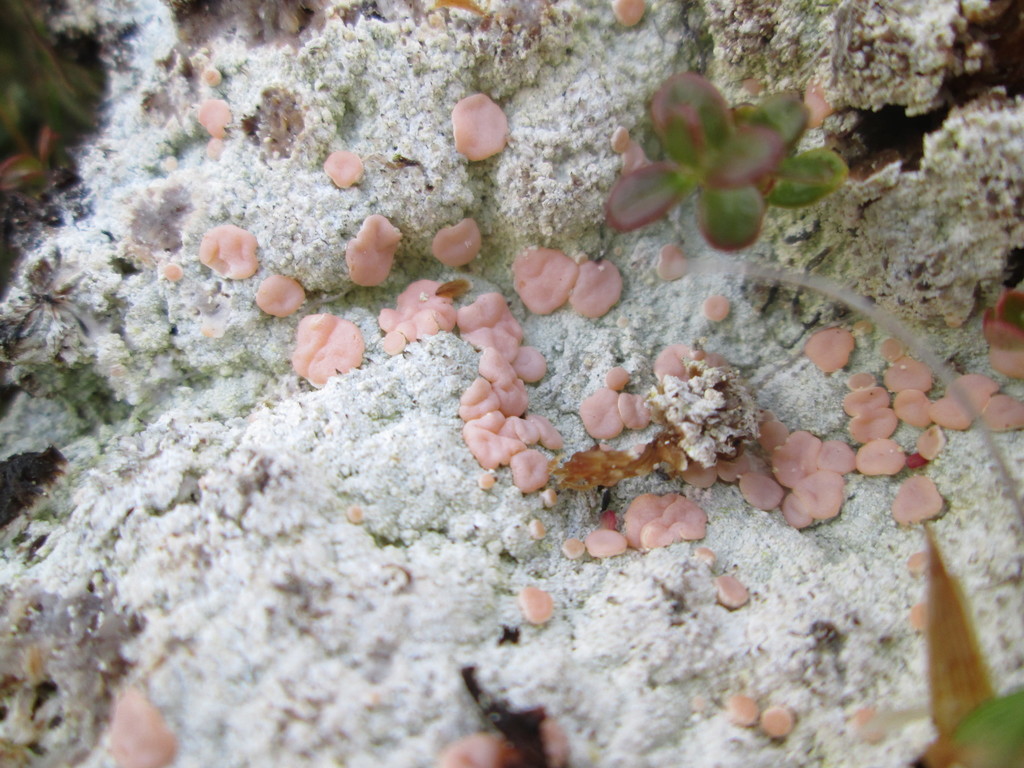
A pale mint-green to bluish-green crust dotted with flat, salmon-pink discs, Icmadophila ericetorum looks as if someone has spilled pastel candy over a rotting log. In North America its colouring has earned it the nickname "fairy barf"; in Britain it is called candy lichen or spraypaint.
The crust is granular to warty and can spread widely over well-rotted wood, peat and mosses. It is green when wet and paler grey-white when dry. The pink apothecia (about 0.5–4 mm) sit directly on the crust, often with a fine powdery bloom and a whitish rim that disappears with age.
It grows on or near the ground in cool, damp places, often on logs and stumps far gone in decay.
Identification
- Pale mint-green to blue-green granular crust over rotting wood, peat or moss.
- Flat, unstalked, pale pink to orange-pink discs (0.5–4 mm), often with a whitish rim.
- Thallus K+ yellow to orange, P+ orange, UV+ blue-white (thamnolic and perlatolic acids).
- Dibaeis baeomyces has round pink heads on stalks and grows on bare mineral soil.
- Baeomyces rufus has brownish caps on short stalks, usually on soil or stone.
Ecology & Habitat
Colonises well-rotted wood, peat and the mosses and liverworts growing on them, nearly always at or near ground level in humid woodland, bogs and moorland. It can grow over mosses aggressively and form extensive patches on old logs and stumps.
Fun Facts
It is the only Icmadophila species in North America, and the type species of its genus.
Its English names are a small catalogue of descriptions: candy lichen, spraypaint, heath lichen and, less politely, fairy barf.
The species name ericetorum means "of heaths", reflecting its frequent habitat on moorland peat.
Distribution
Widespread in Europe (including Britain) and North America, mostly in cool, humid regions